

If you are responsible for picking the next platform that runs your content production, 2026 is a different shopping environment than even two years ago. The category has matured. AI features have moved from demos to default expectations. EU procurement teams now treat data residency as a gating question, not a nice-to-have. And the budget conversation has shifted from per-seat licensing to total cost of operation across a multi-tool stack.
This guide is the framing piece. Once you have a shortlist, the scored evaluation framework is the deeper companion - a working spreadsheet for running an apples-to-apples comparison across vendors. Use this article first to set the criteria, then pick up the framework when you start scoring.
TL;DR
- Define scope before features. A workflow tool, a DAM, and a full content operations platform solve different problems - only one of them removes the seams between tools.
- AI capability is now table stakes. AI transparency - what the model does, where it runs, what it stores - is the differentiator.
- EU data residency and GDPR are procurement gates in 2026, not nice-to-haves. Ask vendors for evidence, not assurances.
- Integration breadth (PIM, ERP, e-commerce, DAM) decides how much your studio still has to do by hand after go-live.
- Published, transparent pricing predicts how the rest of the relationship will go. So does vendor stability and a credible roadmap.
Define the scope before you compare features
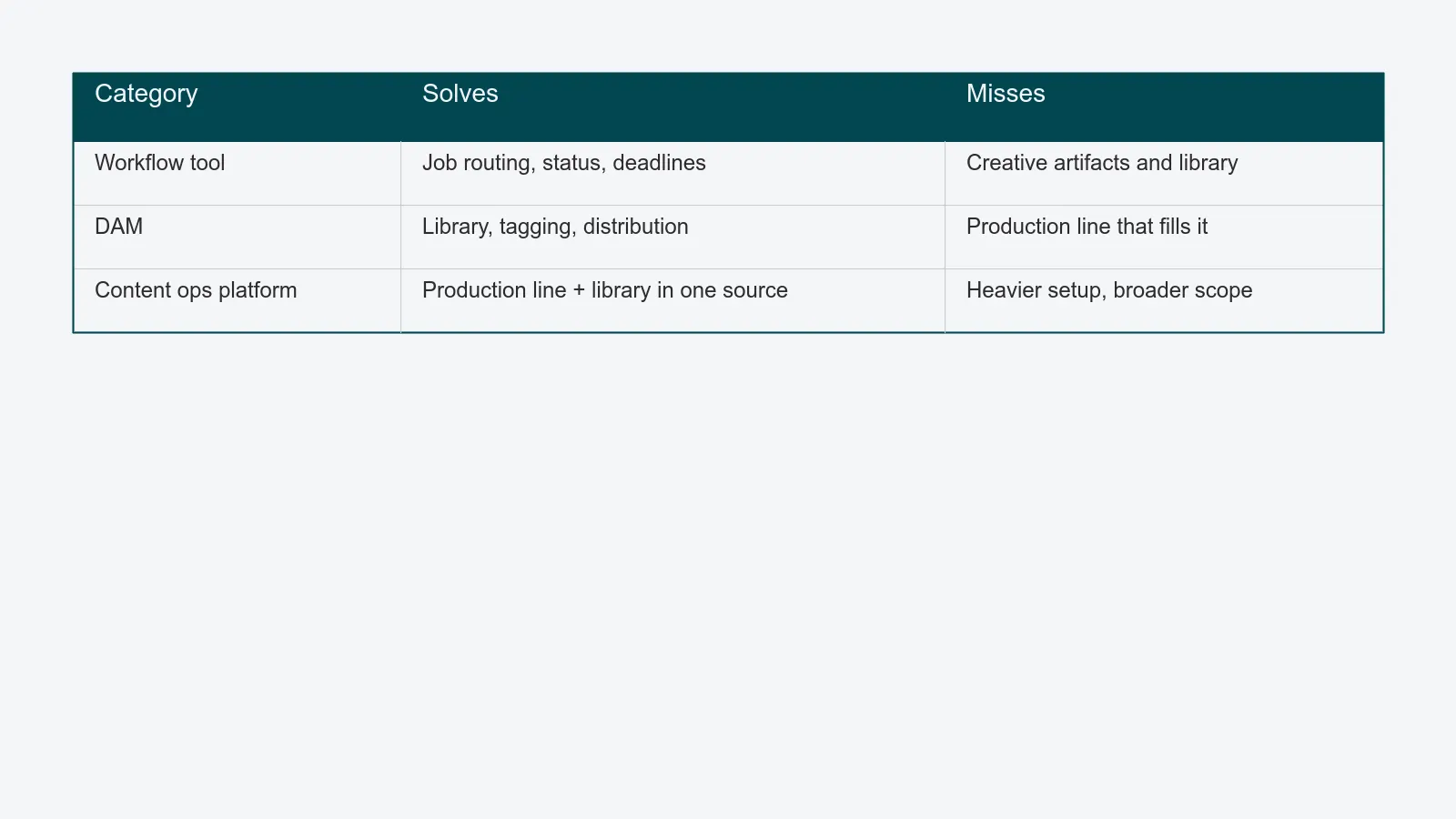
The first mistake studios make when choosing content operations software is shopping the feature list before agreeing on the scope. The category contains at least three different products wearing similar labels:
- A workflow tool automates job routing - intake, assignments, status, deadlines. It is excellent at moving cards across columns, weak at handling the actual creative artifacts.
- A digital asset management (DAM) stores, tags, and distributes finished assets. It is excellent at the library, weak at the production line that fills it.
- A content operations platform unifies the production line and the library - sample tracking, capture, retouching queues, review, delivery, and the DAM behind it - in one source of truth.
If your real pain is "we can't find finished assets," a DAM may be enough. If the pain is "we can't see where jobs are," a workflow tool may be enough. If the pain is "we run six tools and still chase status in Slack," you are shopping for a content operations platform. Decide which sentence describes your studio before you take a single demo. The workflow overview and DAM overview are useful framing for that conversation.
AI capability - and transparency about it
Every vendor in 2026 has an AI page. The interesting question is not whether they have AI; it is what the AI actually does, where it runs, and what it does with your data.
Three questions separate serious AI from theater:
- What concrete tasks does it automate? Background removal, automated tagging, color-aware cropping, similarity search, transcript-from-video - name the tasks, with measurable accuracy on your kind of imagery. Fashion-on-mannequin is not the same problem as cutlery on white.
- Where does inference happen, and what is retained? EU-hosted inference with no training on your data is the safe answer. "It depends on the feature" is the answer you most often get; ask for it in writing.
- What happens when the AI is wrong? Mature platforms route low-confidence outputs to a human review queue automatically. Brittle ones silently publish bad results.
A useful rule: if a vendor cannot explain the boundary of their AI clearly - what it will and will not do - they have not deployed it at scale yet. Pilot accordingly.
EU data residency and GDPR are procurement gates
European procurement teams have hardened on this since 2024, and 2026 is the year it shows up in every serious RFP. According to the Chambers 2026 EU Data Protection and Privacy practice guide, the interaction of GDPR with the AI Act, NIS2, and DORA means buyers now expect documented data flows, in-region processing, and evidence-first compliance - not promises in a sales deck.
For a content operations platform, the practical checklist is short:
- Hosting region. Is customer data stored and processed inside the EU/EEA, with no opportunistic transfer to US infrastructure?
- Sub-processors. Is the sub-processor list public, and does it stay in-region for any service that touches customer content?
- Data Processing Agreement. Is a standard DPA available without a months-long negotiation?
- AI training. Is your data excluded from any model training by contract, not just by policy?
PixelAdmin's posture on these is documented on the security page - EU-hosted on Microsoft Azure, GDPR-compliant by design, Danish company, Danish and English support. Whatever you choose, ask for the same thing in writing.
Integration breadth: PIM, ERP, e-commerce
A content operations platform that does not integrate with the rest of your business is just a prettier silo. By 2026, the integrations that matter for a studio are predictable:
- PIM (Akeneo, Bluestone, inRiver, Pimcore) for product metadata in and final assets out
- ERP (Microsoft Dynamics, SAP, Business Central) for job costing and invoicing
- E-commerce (Shopify, Centra, commercetools, Magento) for direct delivery to product detail pages
- DAM and CMS for downstream distribution to brand sites, social, and partner portals
- Identity (Microsoft Entra, Google Workspace) for SSO and SCIM provisioning
Ask three concrete questions: which of these integrations exist today, which require a connector or partner, and which are on the roadmap with a date. Demand a reference customer using the integration in production. "We can build it" is not an integration; it is a project.
Pricing transparency and total cost of ownership
Published pricing is not a courtesy in 2026. It is a signal. Vendors who hide their pricing usually price by what they think you will pay, which makes year-three renewals unpredictable. PixelAdmin's pricing page lists the tiers and what each one includes openly, exactly so you can build a business case without a sales call - and so the renewal conversation in year three is the same conversation the next buyer is having.
When comparing total cost of ownership over three years, include four lines that buyers usually forget:
- The tools you will retire (Asana, spreadsheet trackers, WeTransfer, ad-hoc review tools) and their real cost, including admin time
- Implementation and migration, scoped in writing with a fixed price or a not-to-exceed
- Storage growth, because content libraries grow predictably and over-tier penalties hurt
- Integration build cost for anything not in the standard connector set
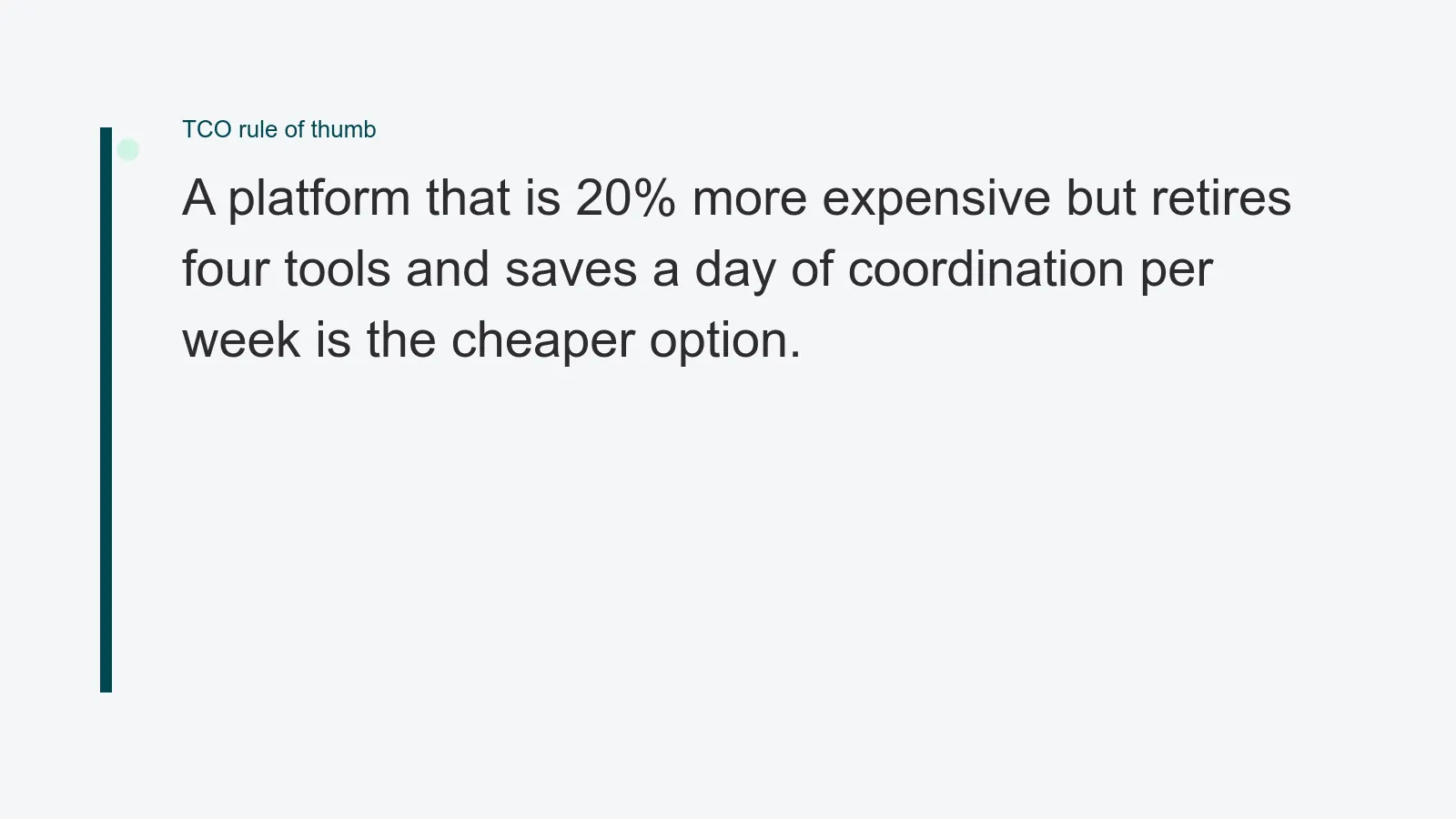
A platform that is 20% more expensive but retires four tools and saves a day of coordination per week is the cheaper option. Run the math.
Vendor stability, roadmap, and fit with your studio size
The last filter is whether the vendor is a fit for the next three years, not just this quarter. Three checks that surface this quickly:
- Stability. Funding posture, customer count, churn signals, average tenure of the leadership team. A platform you depend on cannot afford to disappear.
- Roadmap credibility. Ask for the last four releases and the next two quarters. Vendors who have shipped on cadence will share it; vendors who have not will hedge.
- Studio-size fit. A platform built for in-house brand studios may be over-configured for a 10-person commercial studio, and vice versa. The in-house studios solution page and the commercial studios solution page describe the two profiles PixelAdmin is built for; ask any vendor to point you at their equivalent.
Avoid "we serve everyone" answers. Vendors that serve everyone serve no one well, and you will feel it during the first edge case.
Where to go next
When you are ready to score vendors, the scored evaluation framework gives you a working spreadsheet you can pressure-test against any shortlist.
PixelAdmin is built specifically for high-volume packshot studios and in-house brand studios that have outgrown a stack of generic tools. If that profile fits, book a demo and we will walk your selection criteria through the platform with you - including the parts where we are not the right fit, which is usually the most useful conversation in the room.