

If you run a high-volume content studio, GDPR is not an abstract legal topic. It is baked into every shoot you produce, every retouch handoff you send to a freelancer, and every archive folder that quietly accumulates ten years of model imagery. GDPR for content studios is, in practice, an operations problem: who is in your data, why, with whose consent, for how long, and processed by whom.
This guide walks Heads of Content Production through what actually applies under the General Data Protection Regulation, where most studios are exposed, and how to structure your platform, contracts, and retention so an audit - internal or from a brand client - does not derail production.
This is not legal advice. Treat it as a structured starting point and validate the specifics with your data protection officer or counsel.
TL;DR
- A photograph of an identifiable person is personal data. It only becomes special-category biometric data when processed for unique identification (for example, facial recognition).
- For commercial shoots involving identifiable models or staff, explicit, informed consent is the cleanest legal basis - and it has to be revocable.
- Model releases need to be tied to your asset library so you can prove consent and withdraw assets when consent is revoked.
- Every external retoucher, AI vendor, or storage provider that touches your images is a processor and needs a Data Processing Agreement under Article 28.
- EU data residency is not a marketing line - it materially simplifies your transfer story under Chapter V GDPR.
What counts as personal data in a studio
Under Article 4 GDPR, "personal data" is any information relating to an identified or identifiable natural person. In a content studio, that almost certainly includes:
- Model and talent imagery - RAW, retouched, and outtakes
- Behind-the-scenes photography and video that captures staff or visitors
- EXIF and embedded metadata that ties an image to a specific photographer, device, or location
- Sample logs, shoot schedules, and call sheets that identify people
- Comments and approvals from named clients in your review tool
Recital 51 of the GDPR clarifies that photographs are not automatically special-category data. They become biometric data under Article 9 only when processed "through a specific technical means allowing the unique identification or authentication" of a person - typical examples are facial recognition or biometric search. The European Data Protection Board's Guidelines 3/2019 on video devices lay out the same logic.
Practical implication: if your AI tagging or search starts identifying individuals across shoots, you have likely crossed into Article 9 territory and need a stronger basis and a DPIA.
Choosing a legal basis: consent vs legitimate interest
Article 6 GDPR offers six legal bases. For commercial content production, two are realistic:
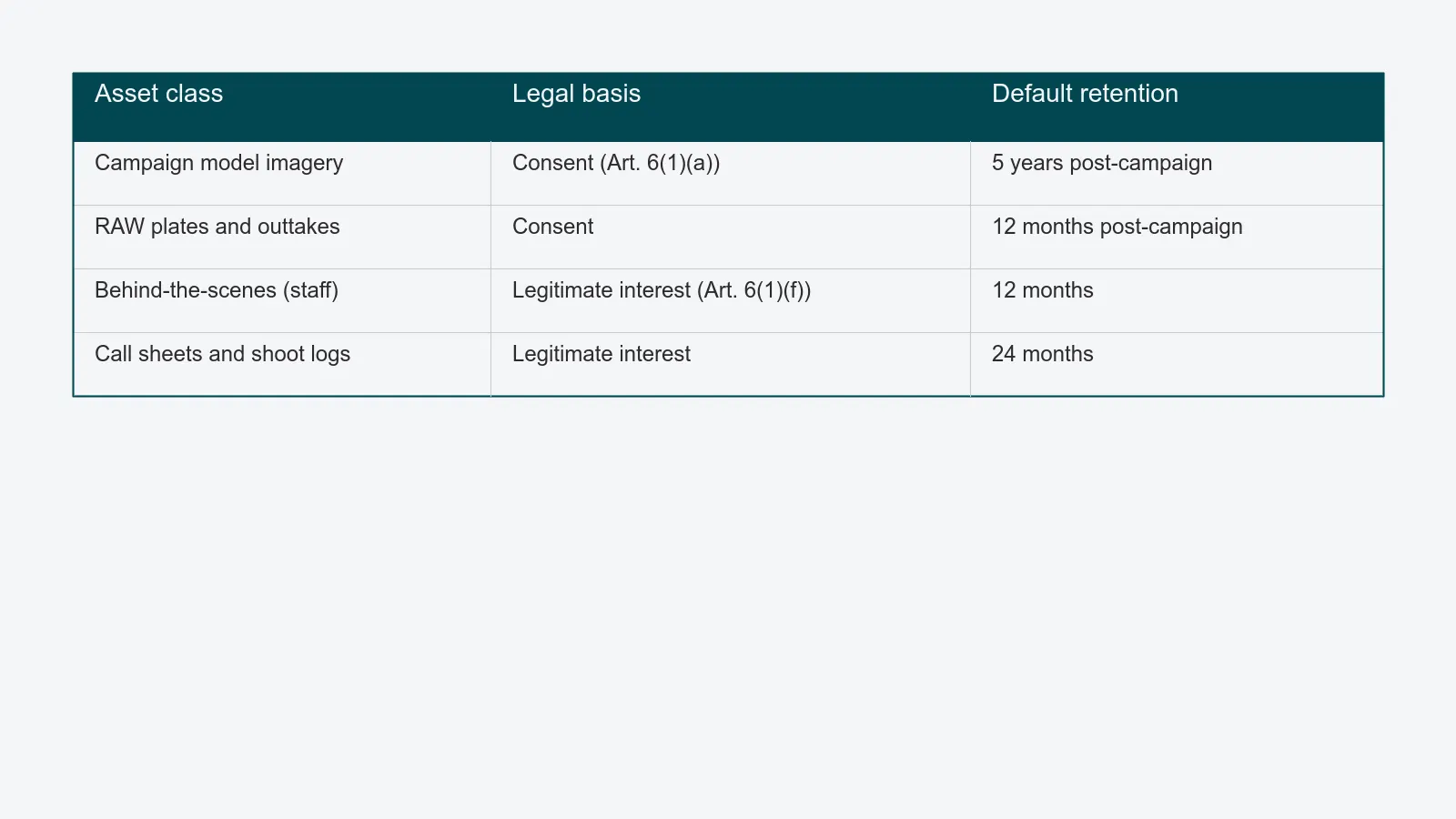
- Consent (Art. 6(1)(a)) - best fit for model imagery used in marketing. Must be freely given, specific, informed, unambiguous, and as easy to withdraw as to give.
- Legitimate interest (Art. 6(1)(f)) - sometimes appropriate for internal-only behind-the-scenes documentation, with a documented balancing test.
For models and external talent, default to consent. For employees in BTS material, be cautious: the imbalance of power means consent is rarely "freely given," and a documented legitimate-interest assessment plus a clear opt-out tend to hold up better. Danish, German, and French DPAs have all signalled this in employer-photo guidance over the last few years.
Model releases that work under GDPR
A traditional model release was a copyright and likeness document. Under GDPR, it also has to function as a consent record. A studio-grade model release should capture:
- Identity of the controller - your studio, or your brand client if they are the controller.
- Specific purposes - campaign, channels, geography, duration. Vague "any and all uses" wording is increasingly hard to defend.
- Categories of recipients - retouch partners, agencies, your client, third-party platforms.
- Retention period - how long the imagery will be stored and used.
- Withdrawal mechanism - how the model contacts you to revoke and what happens next.
- Transfers outside the EEA - if any, with the safeguard relied on (SCCs, adequacy).
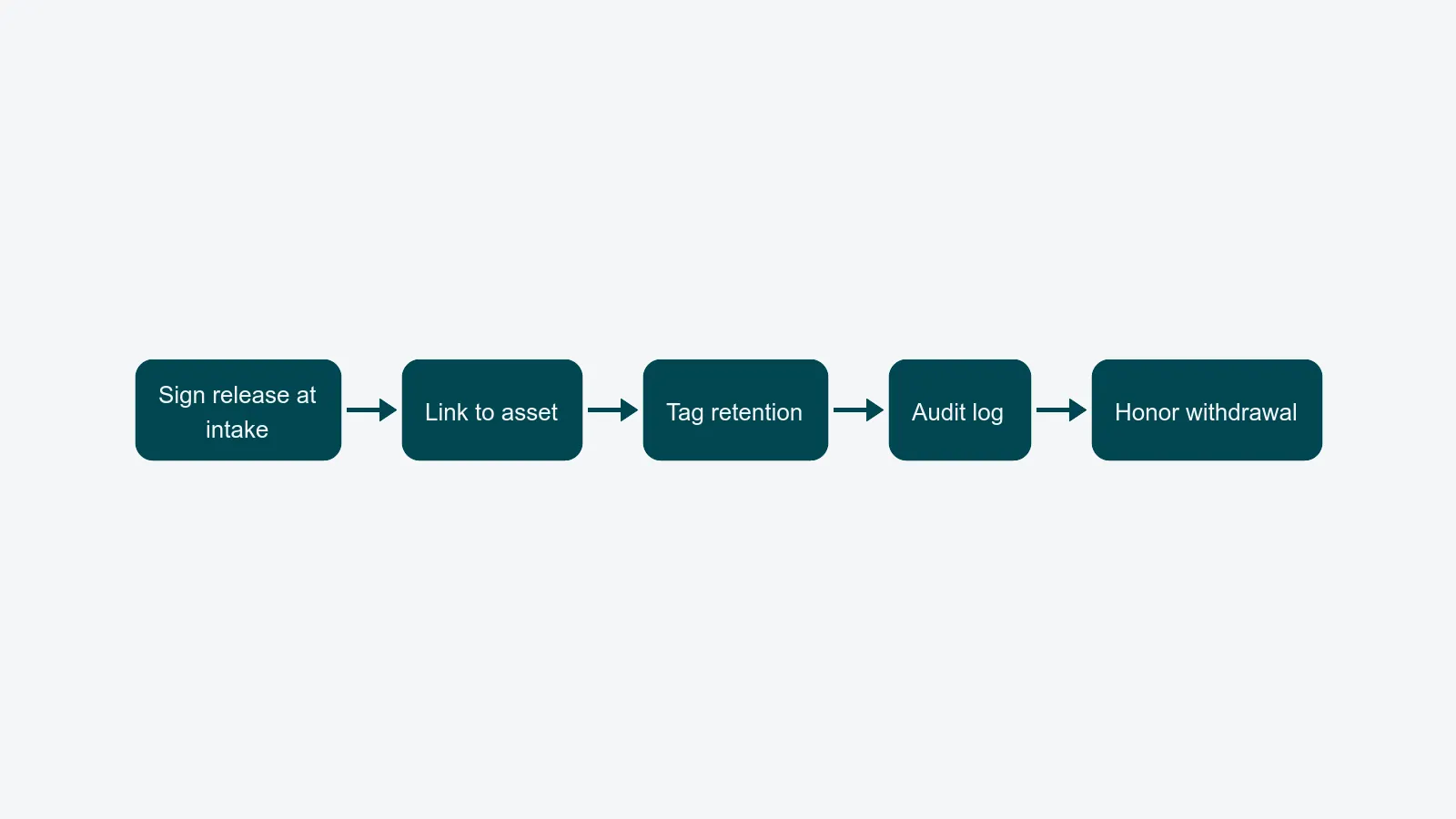
Critically, the release must be linked to the asset in your platform. A signed PDF in a shared drive is not enough if you cannot prove, two years later, which images that release covered. Tying release records to assets at ingest is exactly the kind of thing a digital asset management system and a structured sample and intake workflow are built for.
Retention, erasure, and the right to be forgotten
Articles 5(1)(e) and 17 GDPR require that personal data is kept "no longer than necessary" and erased on request, subject to limited exceptions. For a content studio, this means:
- Define retention periods per asset class - for example, raw plates 12 months after campaign end, approved campaign assets 5 years, internal BTS 12 months.
- Make retention enforceable in the system, not in a spreadsheet - schedules that depend on someone remembering to delete are not defensible.
- Provide a documented erasure path when a model withdraws consent. That includes the master, the renditions, the cached previews, and the backups (subject to backup-rotation realities, which most DPAs accept if documented).
- Watch your archive drives. Old NAS volumes containing un-tagged campaign material are the single most common GDPR exposure we see in studio audits.
A unified asset library with retention rules attached to metadata fields is the practical answer here. Loose folders are not.
Processing by vendors: DPAs with retouch agencies and freelancers
Every external party that processes personal data on your behalf is a processor under Article 28 GDPR. For a content studio, that typically includes:
- Freelance retouchers and retouching agencies
- Production agencies and casting partners
- AI tooling providers that process images server-side
- Storage, DAM, review, and delivery platforms - including PixelAdmin
You need a written Data Processing Agreement with each, covering subject matter, duration, purpose, types of data, sub-processors, security measures, and assistance with data-subject requests. Brand clients increasingly require you, the studio, to flow these obligations down to your own freelancers - and to evidence it.
PixelAdmin operates as your processor when you use the platform. Our Data Processing Agreement and privacy policy document the terms, and a list of sub-processors is available on request.
Data residency: why EU hosting matters
Chapter V GDPR restricts transfers of personal data to countries outside the EEA without an appropriate safeguard. After Schrems II and the 2023 EU-US Data Privacy Framework, the legal landscape has stabilised, but it has not gotten simpler - especially for brand clients with strict procurement.
Hosting your platform in the EU does not solve the transfer question entirely (sub-processors and support models still matter), but it removes the single biggest variable. PixelAdmin runs on Microsoft Azure with EU data residency, and Azure's EU regions sit on the kind of physical and operational security baseline most studios cannot replicate themselves. Details of our infrastructure posture are on the security page.
Incident response: what you need before something happens
Article 33 GDPR requires notification of a personal-data breach to the supervisory authority within 72 hours of becoming aware of it, where feasible. You will not write a defensible response in 72 hours from a standing start. What you need ready in advance:
- A documented incident response process with named owners
- Logging that lets you reconstruct who accessed which assets and when
- A contact path for your processors (so you find out quickly if they are breached)
- Pre-agreed templates for client and data-subject communications
Audit logging and access control inside the platform are not "enterprise nice-to-haves" - they are the foundation of an Article 33 timeline.
Practical GDPR checklist for content studios
Before your next brand-client security review, run through this:
- Every asset class has a defined legal basis and retention period
- Model releases are linked to the assets they cover and stored centrally
- Withdrawal of consent triggers an erasure workflow you have actually tested
- You have signed DPAs with every external retoucher, agency, and tooling vendor
- You know which sub-processors your platform uses and where they sit
- Your data is hosted in the EU, or you can document the transfer safeguards
- Audit logs let you answer "who accessed this asset and when" in minutes
- You have a rehearsed incident response runbook with a 72-hour clock in mind
- A DPIA exists for any AI feature that performs identification across shoots
If three or more of these are uncomfortable, your exposure is operational, not legal - and that means it is fixable with the right platform and process.
Where to go next
GDPR work in a studio is rarely about reading the regulation. It is about getting consent, retention, processors, and access logging into a single system that produces evidence on demand. Our security posture, DPA, and privacy policy document the foundation we provide; how you wire your shoot intake, sample handling, and asset library determines the rest.
If you would like to walk through your current setup against this checklist, book a call and we will go module by module.