

A buyer pings the marketing team at 16:30 on a Friday: the autumn campaign is still live on the regional site, but the model contract expired last Sunday. Nobody noticed. The hero image is now an exposure - a complaint to the Data Protection Authority, a takedown demand, a renegotiation at gunpoint. The image lived in the DAM all along. The contract lived in a SharePoint folder. The expiry date lived in a producer's head.
This is the gap image rights DAM governance is supposed to close. Not "we have a DAM," not "we scan releases" - a system where every asset carries the rights metadata that makes it legal to use, and where the platform refuses to serve it when those rights run out.
TL;DR
- Image rights and asset governance live in structured metadata, not in a release PDF buried three folders deep.
- Six fields cover most studio scenarios: licensor, licence type, territory, expiry, release ID, usage scope.
- Automated expiry alerts move the cost of a lapse from "campaign blow-up" to "ticket in a queue 30 days out."
- Releases and contracts have to be linked to assets so legal can answer "show me the consent for this image" without a search party.
- Role-based access is what keeps unreleased product photography out of screenshots, leaks, and well-meaning resharing.
The rights metadata fields every studio asset needs
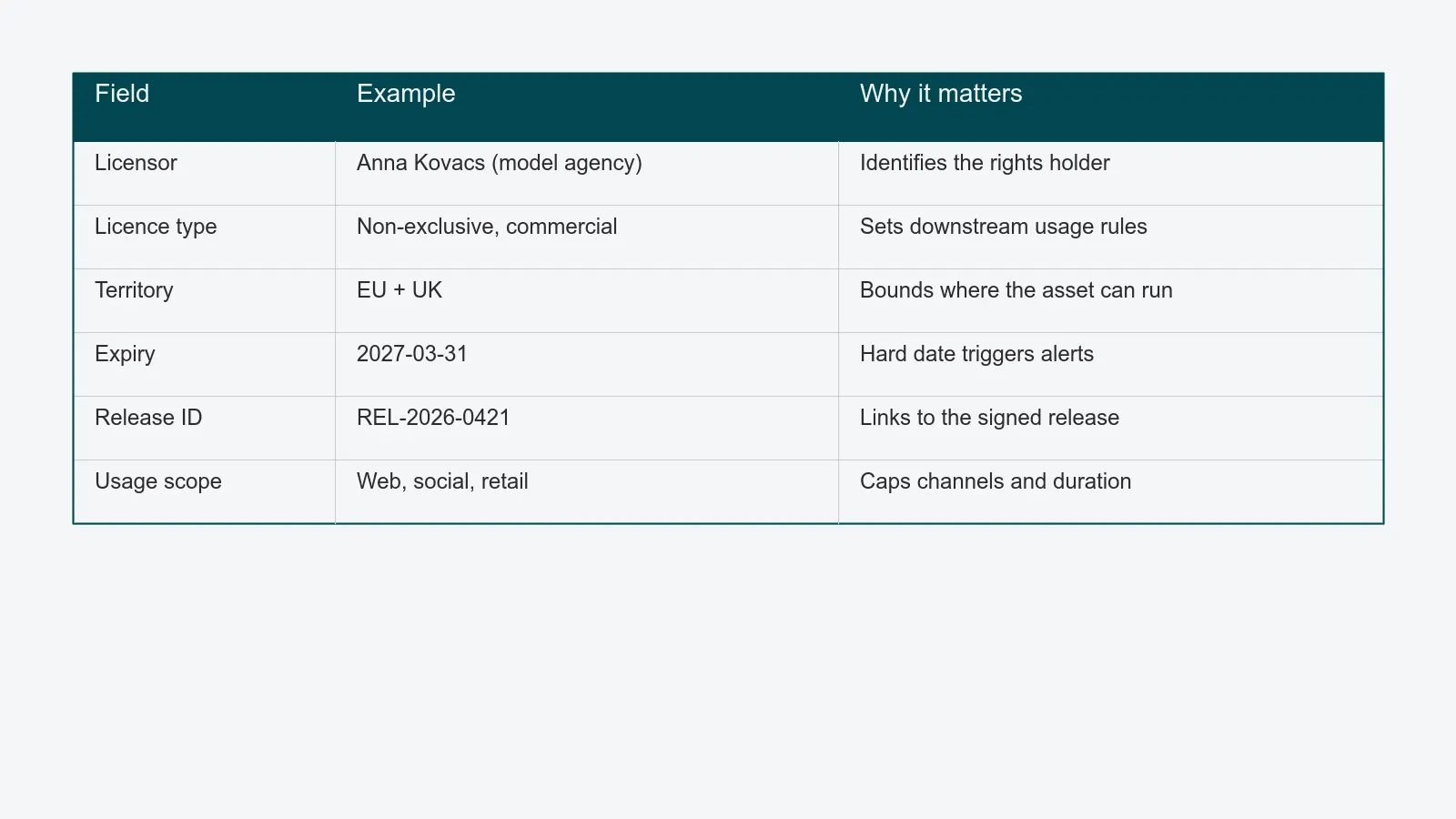
A shared drive can hold a JPG, but it cannot hold the question "are we allowed to use this on Friday?" That answer is structured data. The minimum fields that belong on every commercial asset:
- Licensor - the rights holder. The model, agency, photographer, music supplier, prop owner, brand partner, or stock library. One asset can have several.
- Licence type - exclusive, non-exclusive, royalty-free, editorial, internal-only, work-for-hire. Each of these has different downstream rules.
- Territory - EU, EEA, global, specific country list. The same hero might be cleared for Denmark and not for the UK.
- Expiry - a hard date, not "two years from the campaign launch we will probably remember." If the licence is perpetual, write "perpetual" - leaving the field empty is the bug.
- Release ID - a stable identifier that links to the signed model, property, or location release in your contract store.
- Usage scope - channels (web, print, OOH, social, retail), duration, derivative works, paid media. The brief had limits; the asset record needs to remember them.
These are not enterprise nice-to-haves. They are the smallest set of facts that lets your team answer a usage question without re-reading a contract. A purpose-built studio DAM treats them as first-class fields with validation and search; a shared drive treats them as filename hints, which is the same as not having them.
Why a signed PDF in a folder is not "rights tracking"
Most studios already collect releases. The failure is not at signature - it is at the link. A PDF named Release_KovacsAW26_signed.pdf in Legal\Releases\2026\ is evidence that consent existed. It is not an answer to "which 412 master files and 2,840 renditions does this release cover?"
Without a release ID on each asset, your erasure workflow falls apart the first time a model withdraws consent. So does your audit response when a client asks for the consent record behind a specific image. The fix is structural: every release gets an ID, every covered asset references that ID, and the DAM enforces the link at ingest. We covered the consent and retention side of this in the GDPR guide for content studios - rights governance is the operational layer that turns those obligations into searchable, enforceable metadata.
What happens when rights lapse mid-campaign
Three scenarios, in increasing order of cost:
Scenario 1 - quiet expiry. The licence ends, no one in operations knows, the asset stays live across web, social, and retail partners. You only find out when the licensor sends a takedown, or when a journalist notices. Cost: takedown across every channel, possibly a renegotiation at the licensor's terms, possibly a regulator complaint if personal data is involved.
Scenario 2 - the discovery in the audit. A brand client runs a procurement review and asks for licence proof on a sample of 50 assets. Three are out of scope. You spend two weeks reconstructing what was cleared for what, and the client puts the contract on watch.
Scenario 3 - the consent withdrawal. A model exercises their right to withdraw under Article 7(3) GDPR. You have 30 days, sometimes less, to remove every image of them across master files, renditions, distributed copies, and cached previews. Without rights metadata you cannot even produce the list, let alone act on it.
The pattern is the same in all three: the legal exposure is downstream of an operational gap. Automated expiry alerts move the conversation 30 or 60 days earlier, into a calm renewal or substitution decision instead of a takedown.
Linking the DAM to contract and release storage
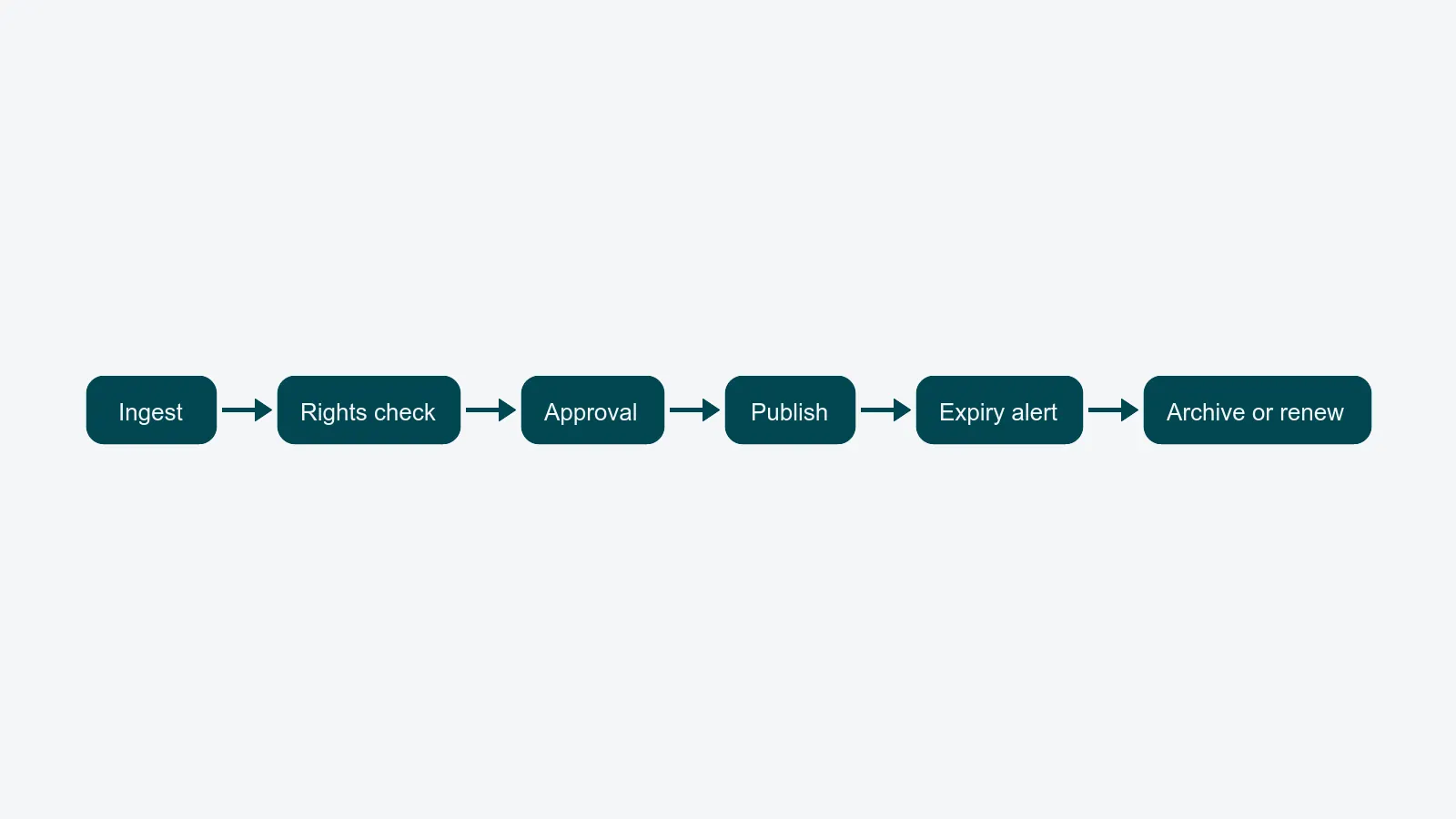
You do not need one system for everything. You need the systems you have to reference each other reliably. A workable architecture for most studios:
- Contracts and releases live in your DMS or contract management tool (SharePoint, DocuSign, Juro, an iManage workspace).
- Assets live in the DAM.
- The DAM stores the release ID and a deep link back to the signed document - not a copy.
- The contract system stores the asset query that resolves to the covered files.
That two-way reference is the unit of governance. When a model withdraws consent, you start in the contract system and pivot to the DAM with one click. When legal asks "where did we use this release?" you start in the DAM and resolve to the document. Neither system needs to absorb the other; they need to agree on the ID.
Role-based access for confidential pre-launch assets
Pre-launch is where asset governance fails most visibly. The campaign hero leaks. A WIP shot ends up in a status deck that goes to fifteen agencies. An influencer reposts a sample image two weeks before embargo.
Folder permissions are not enough here. What you actually need is attribute-based access tied to asset state. An asset tagged embargo: 2026-10-15 is invisible to retail partners until that date. A campaign in state: pre-launch is visible to the core team and one named agency, full stop. A retoucher gets access to RAW files for the SKUs they are assigned to, and nothing else.
This is where role-based access in a purpose-built DAM and the broader security posture - encryption, EU residency on Microsoft Azure, audit logging - start operating as a single control surface. Folder-level permissions on a shared drive do not approximate any of this.
Audit trails your legal team will actually use
An audit trail is only useful if it answers questions in the language counsel asks them. The three questions that matter:
- Who accessed this asset, when? Answers data-subject requests and breach reconstruction.
- Who changed the rights metadata, and to what? Answers "did somebody quietly extend the territory?"
- Which assets were served externally during this window? Answers "was the expired image distributed after expiry?"
If your DAM cannot produce those three reports in minutes, the platform is not contributing to compliance - your team is, manually, every time. Our Data Processing Agreement and the security page describe the logging and processor obligations PixelAdmin operates under; the value of that infrastructure is that your audit answers come out of the system, not out of a producer's recollection.
Practical asset governance checklist
Run through this before the next brand audit:
- Every commercial asset has the six rights fields populated, or a documented exception
- Every release has a stable ID referenced on every covered asset
- Expiry alerts fire 60 and 30 days before lapse, to a named owner
- Withdrawal of consent triggers an erasure workflow you have actually tested end to end
- Pre-launch assets are gated by state and role, not by hopeful folder structure
- Audit logs answer "who, what, when" on access and metadata change in minutes
- Heads of content production and legal review the rights schema together once a year
If three or more of these are uncomfortable, the exposure is operational. The fix is a DAM that treats rights as metadata, not as an afterthought.
Where to go next
Image rights work in a studio is rarely about reading licences harder. It is about getting rights metadata, release IDs, and access state into a single library that produces evidence on demand and refuses to serve assets that should not be live. Walk through your current asset library against this checklist, and the gaps will be operational rather than legal - which means they are fixable.
If you would like to do that walk-through with us, book a session and we will go module by module across rights, releases, access, and audit.