

If you run a content studio in 2027, "where does our data live?" is no longer a question your IT team answers in a footnote. Brand procurement asks it on the first call. Auditors ask it before they look at anything else. Your own DPO asks it every time you swap a tool. And the answer for creative teams is harder than for most SaaS buyers, because the data is bigger, more personal, and more entangled with third parties than a row in a CRM. EU data residency for creative teams is the single most consequential clause in your next vendor contract.
This guide is for Heads of Content Production weighing an EU-hosted platform against a US-hosted one. It covers what residency actually means for raw captures and retouched masters, the Schrems II implications still in play, the questions to ask a vendor, how to verify the answers, and the trade-offs you accept either way.
TL;DR
- Data residency is about where data is stored, processed, backed up, and accessed from - not just the marketing region label.
- For creative teams, the data in scope includes raw captures, retouched masters, model releases, contracts, review comments, and embedded EXIF/IPTC metadata that quietly carries personal data.
- US-hosted vendors are not illegal under GDPR, but they require a documented Chapter V transfer story that brand clients increasingly want to see in writing.
- Verification matters more than claims. Ask for region pinning in configuration, the DPA, the sub-processor list, and audit reports - not a slide deck.
- Trade-offs are real: EU-only narrows the vendor field, can add latency for global teams, and sometimes costs more. The win is a defensible compliance posture.
What "data residency" actually covers in a creative pipeline
Most SaaS data is small and structured: rows, fields, transactions. Creative pipelines are different. A single campaign can produce terabytes of mixed material, all of it linked to identifiable people in some way:
- Raw captures - RAW files from tethered shoots, often containing model imagery and embedded GPS, device, and photographer metadata in EXIF.
- Retouched masters and renditions - TIFFs, layered PSDs, exported JPGs and AVIFs across multiple channels.
- Model releases and contracts - signed PDFs that are themselves personal data and the legal basis for everything else.
- Review comments and approvals - named client feedback inside the platform, which under GDPR is also personal data.
- Embedded metadata - IPTC fields naming photographers, agencies, and rights holders; XMP sidecars carrying retouching history.
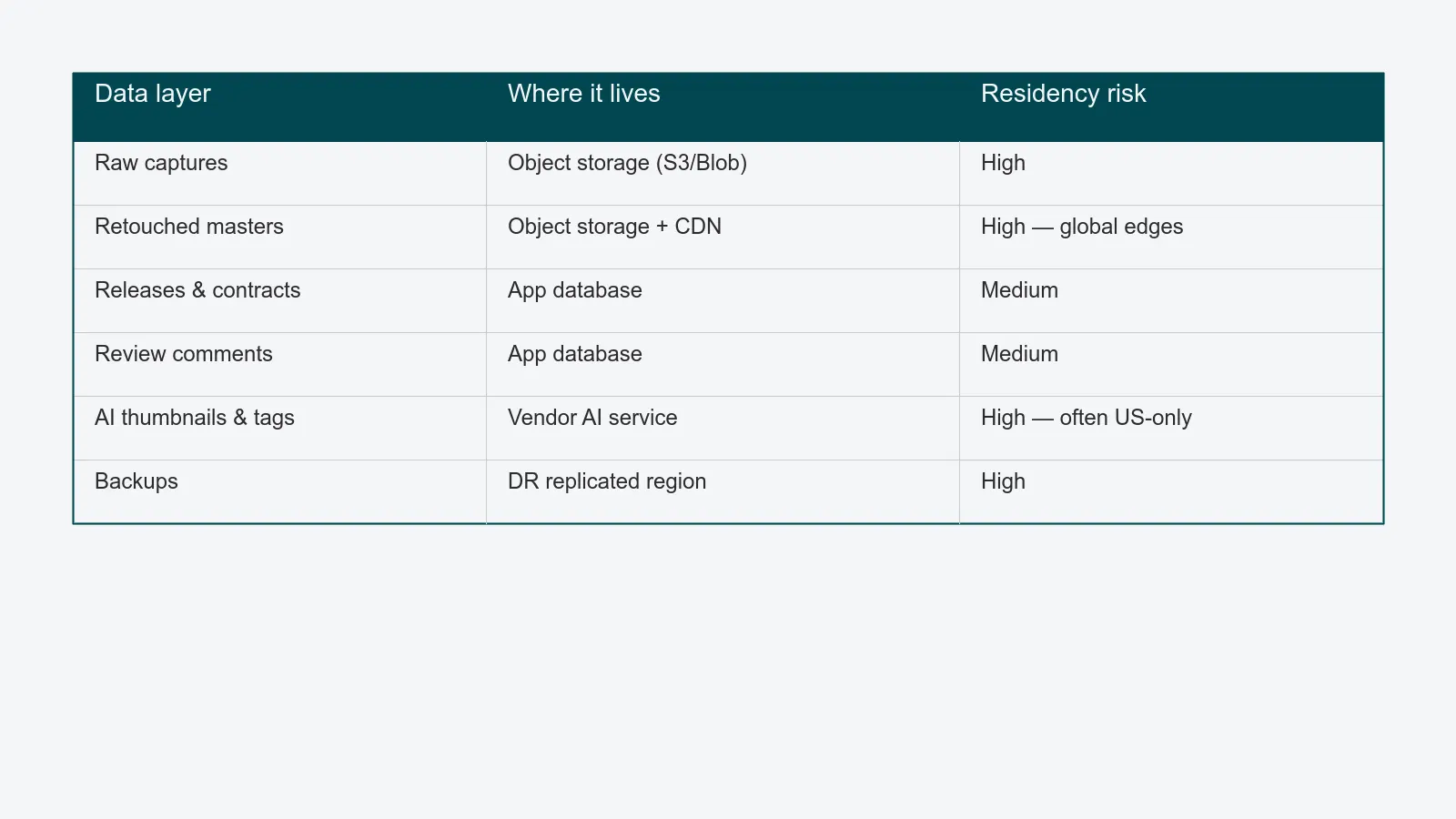
Residency questions need to cover all of this - not just the database. A vendor that stores its application database in Frankfurt but its blob storage of master files in us-east-1 has not given you EU residency in any meaningful sense. The same applies to thumbnails generated by an AI service, transcripts cached by a search index, or backups replicated cross-region for disaster recovery.
Our companion piece on image rights and asset governance in the DAM goes deeper on the metadata side; this article focuses on the hosting layer underneath.
Why Schrems II still shapes the 2027 vendor landscape
The 2020 Schrems II ruling invalidated Privacy Shield and made transfers of personal data to the US conditional on Standard Contractual Clauses plus a documented assessment. The 2023 EU-US Data Privacy Framework restored an adequacy decision for participating US companies, but the legal challenges to it are ongoing, and several DPAs continue to scrutinise it.
In practice this means three things for a 2027 vendor selection:
- EU adequacy is the simplest path. Hosting and primary processing inside the EEA, or in an adequacy-decision country, removes most of the transfer paperwork.
- DPF reliance is contingent. A US vendor relying solely on the Data Privacy Framework should be able to describe what they will do if the framework is invalidated - many cannot.
- SCCs are not a checkbox. They require a Transfer Impact Assessment that considers the importing country's surveillance laws. Brand clients with strict procurement increasingly want to see your TIA, not just the executed SCCs.
Your model release and consent practice is the what; residency is the where. The two have to agree before either is defensible.
Eight questions to ask any SaaS vendor
Send these in writing before any commercial conversation. The shape of the answers - concrete vs evasive - tells you most of what you need to know.
- Where is the primary storage region? Name the cloud, the region, and the service (object storage, database, search index).
- Where are backups stored? Cross-region replication is normal for resilience, but the replica region matters for residency.
- Where is the data processed? Application servers, AI workers, image transcoding, and search indexing can all live in different regions.
- Who are the sub-processors, and where do they sit? Ask for the full list, not a summary. Look for support tools, analytics, error monitoring, AI vendors.
- What is the transfer mechanism for any non-EEA flows? Adequacy, SCCs, BCRs, or DPF - and the supporting TIA.
- Where are encryption keys held, and who can access them? Customer-managed keys in an EU Key Vault are stronger than provider-managed keys in a different region.
- Where does support access data from? A US-based support team logging into an EU tenant is a transfer, even if the storage stays in the EU.
- Can residency be enforced in tenant configuration, or is it a contractual promise only? Region pinning in the product is verifiable; a contract clause is not.
How to verify the answers, not just collect them
Claims are cheap. The verification layer separates a defensible vendor selection from one that falls apart in a brand audit. Three things to insist on:
Read the DPA carefully. A serious vendor will publish their Data Processing Agreement and let you mark it up. Look for the data location annex, the sub-processor list, and the transfer mechanisms section. If those are blank or "available on request" with no NDA, treat that as a flag.
Ask for audit reports. ISO 27001 and SOC 2 reports describe the actual controls - including data centre location and access. Even a SOC 2 Type 1 from a small vendor tells you more than a marketing page.
Test the configuration. If the vendor offers region pinning, ask to see it in a sandbox tenant. Open the asset upload flow and check the URL the file is being sent to. Read the response headers. A vendor that hesitates to let you do this is telling you something.
For brand clients with their own security teams, the trio of DPA + sub-processor list + audit summary is now the de facto minimum. Have it ready before they ask.
The trade-offs you accept with EU-only

EU residency is not free, and you should walk in with eyes open:
- Latency. A US-based retoucher uploading to an EU tenant will see longer round-trips than to a US tenant. For most creative workflows the difference is invisible; for very large RAW transfers it can add minutes per session.
- Vendor field narrows. Some otherwise excellent tools are US-only. You may end up assembling a slightly different stack than a US-headquartered peer would.
- Cost. EU regions are sometimes priced higher than US regions on the underlying cloud, and that filters into vendor pricing.
- Sub-processor discipline. EU residency is only as strong as your weakest sub-processor. A vendor that is EU-hosted but uses a US analytics tool with no EU option has gaps.
Most creative teams accept these trade-offs willingly once a brand client requires written EU residency. The cost of not having a defensible answer - losing a contract, or being deprioritised in procurement - is higher than the latency or pricing delta in almost every case.
Practical residency checklist
Before your next platform decision, walk through this:
- You can name the primary storage region, the backup region, and the processing region for every system handling assets
- The vendor publishes a DPA with a data location annex and a sub-processor list
- Any non-EEA transfers have a documented mechanism and a TIA you can show a brand client
- Encryption keys for production data sit in an EU key store
- Support access from outside the EEA is either prohibited or governed by a documented SCC flow
- Region pinning is a configuration setting in the product, not just a contract clause
- You have a current ISO 27001 or SOC 2 report on file from each major vendor
- Your own model release and retention policies match the residency story
If two or more rows are uncomfortable, the gap is operational, not legal - which means it is fixable.
Where to go next
Data residency in 2027 is less about reading regulation and more about turning vendor claims into evidence your DPO and your brand clients can sign off on. PixelAdmin runs on Microsoft Azure in EU regions; our security posture describes the controls and our Data Processing Agreement documents the legal mechanics. If you want to walk through your current vendor stack against the checklist above, book a call and we will go region by region.