

Every studio I have worked with has the same conversation at the start of each season. Someone wants the assets faster - a client, or, for an in-house brand team, the e-commerce channel waiting to go live. The studio promises to "tighten things up." Two months later, the same conversation happens again.
The problem is not effort. The problem is that packshot turnaround time is not one number - it is the sum of six handoffs, and most studios are trying to optimise the wrong one. For an in-house team this is the same as time-to-market: every day a sample sits unshot is a day the product is not live on the site. This article walks through five levers that genuinely move the number, ranked by where you should look first.
Where the days actually go
Before you can shorten anything, you need to know what you are shortening. A typical 14-day packshot turnaround looks like this:
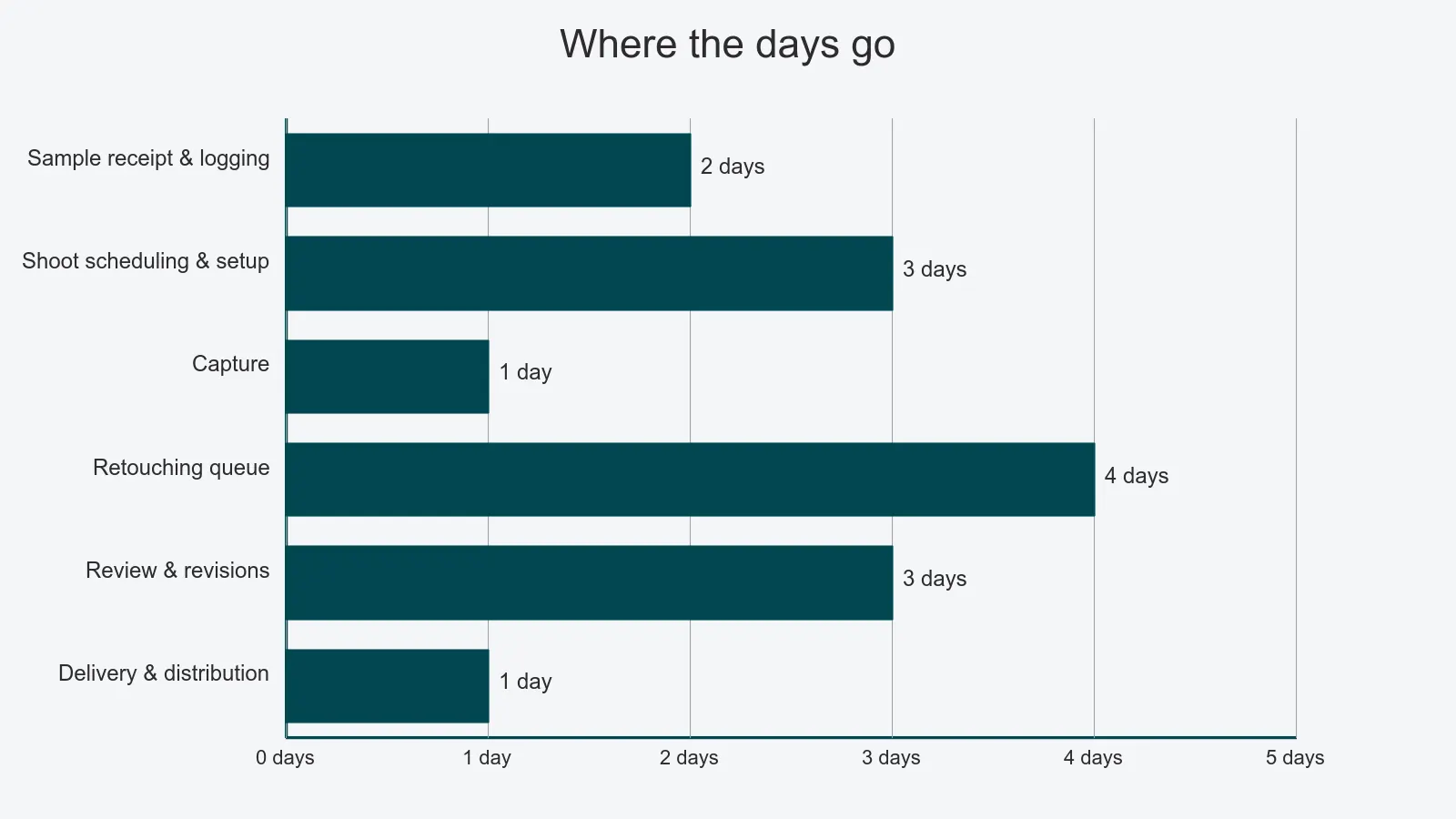
Notice what is not the bottleneck: capture. Most studios obsess over the shoot day because that is the visible, expensive, photographer-on-the-clock part. But the shoot day is one of the smallest contributors to total elapsed time. The big costs are scheduling, retouching queues, and review cycles - none of which are about how fast the camera fires.
Lever 1 - kill the receipt-to-shoot delay
If samples sit in the studio for two days before anyone shoots them, you have already lost two days. This is the easiest lever to pull and the one most studios neglect.
The fix is structural, not motivational. A sample arrives, it is logged within the hour, and a shot is auto-scheduled based on capacity - not "when someone gets to it." This is what sample management connected to studio capacity actually does: the sample's existence triggers the booking, instead of waiting for a producer to notice and act.
Realistic gain: 1–2 days off total turnaround.
Lever 2 - pre-flight the shot list
The second-biggest waste in packshot production is reshoots caused by ambiguous briefs. The stakeholder - a client, or the brand team feeding the webshop - wanted three angles. The shot list said "standard packshot." The photographer shot two. Now you are scheduling a half day to redo it.
Pre-flighting means the brief, the shot list, and the sample are all locked before the shoot is booked, not on the morning of. If the brief is incomplete, the booking does not appear on the calendar. If the sample is missing, the shoot moves automatically. The producer's job becomes resolving exceptions, not chasing details.
Realistic gain: ~10% reduction in reshoot rate, plus calmer mornings.
Lever 3 - flatten the retouching queue
Retouching is the largest single block of elapsed time in most studios - typically 3–5 days of an 14-day cycle. And almost none of that is the actual editing. It is work waiting in a queue because someone has not assigned it, or it is assigned to an editor who is on another job, or the file is sitting in a shared folder waiting for someone to notice it has arrived.
Three sub-levers help.
Auto-assign on capture. The moment a shot leaves capture, it goes to the next available editor, not the one named in a Friday spreadsheet. Editors with capacity get more work; editors with backlogs get less.
Pre-process before retouchers see it. AI-based background removal, exposure normalisation, and crop suggestions can shave 30% off the per-image effort by handling the boring 80% before a human even opens the file. The retoucher's time goes to colour, fabric, and finish - the parts that need a human eye.
Make priority visible. Retouchers should know which job is most urgent without reading a Slack thread. A single queue, sorted by deadline, ends most of the "which should I do next?" questions.
Realistic gain: 1–2 days off total turnaround, larger if AI pre-processing is new to your team.
Lever 4 - review without email
Review is the second-largest queue after retouching, and it is almost entirely communication overhead. Edits are emailed as ZIP files. Feedback comes back as comments in Word documents or screenshots with arrows drawn on them. The retoucher implements changes, sends another ZIP, and the cycle repeats.
A real visual review system collapses this to: stakeholders see the image, click on it, leave a comment, and the retoucher sees the comment in the same view as the image. No email threads. No "did you get the latest version?"
The gain is not just speed. It is also fewer rounds - when feedback is precise and tied to the exact pixel, retouchers do not over-interpret or under-interpret it.
Realistic gain: 1 day off total turnaround, plus measurable reduction in revision rounds.
Lever 5 - distribute on completion, not on request
The final delay is the one nobody counts because it does not feel like part of "production." A retoucher delivers files to a shared folder. Someone downloads them - a client, or, for an in-house brand team, the e-commerce owner whose launch date depends on them. A copywriter pulls them into the PIM. Marketing pulls them into a campaign tool. Each step is a separate request, often manual, often delayed by a day.
If your platform has direct distribution to PIM, e-commerce, and marketing channels, the asset is in every downstream tool the moment QA approves it. Nobody has to ask, and nobody has to remember to download.
Realistic gain: 0.5–1 day off perceived turnaround. Even if the asset is technically done on day 14, the recipient counts it as done when it appears in their PIM - or, for an in-house team, live on the storefront.
Putting it together
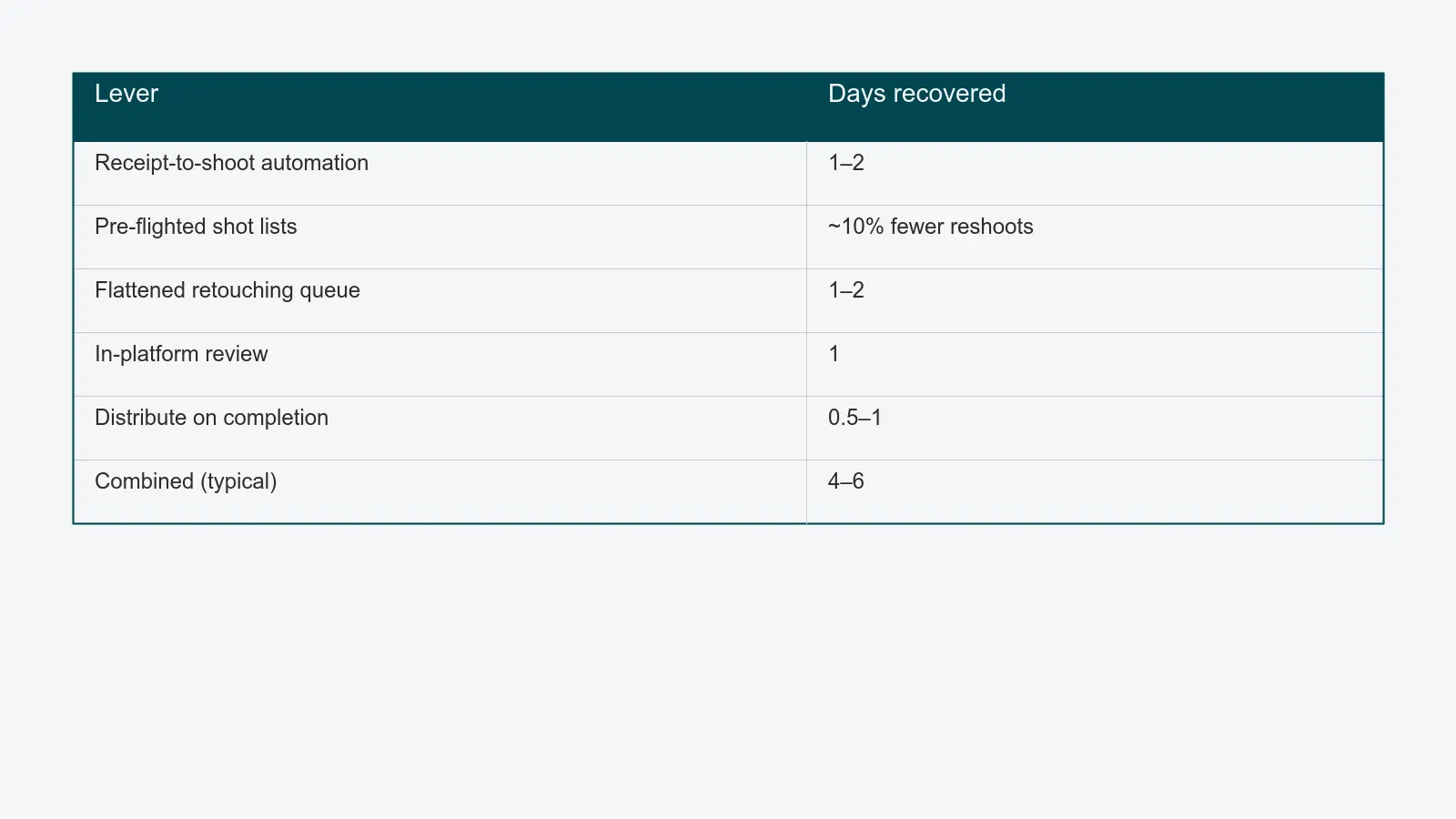
Stack the levers and the math is significant. A studio at 14-day turnaround that pulls four of these levers - receipt automation, pre-flighting, AI pre-processing, in-platform review - typically lands at 8–9 days. That is roughly the difference between "we are slower than the brand expects" and "we are the studio they recommend."
None of these levers require working faster. They require removing wait states. The capture itself stays the same speed. What changes is the time between stages - which is exactly what a unified packshot workflow is built to compress.
What not to optimise
Three things look like they should help and almost never do.
Faster cameras. Tethering speed and burst rate are basically free already. If your turnaround is 14 days, shaving five seconds off a capture saves you nothing.
More photographers. If retouching is the bottleneck (and it almost always is), adding photographers makes the queue worse, not better.
Working evenings. This is the trap every studio falls into. It works for one season and then everyone burns out. Structural changes hold; heroics do not.
FAQ
How long should turnaround actually be? For standard packshots without complex retouching, 5–7 days is achievable for studios on a unified platform. For campaign-quality work with creative retouching, 10–14 days is realistic. If you are above 18 days for standard work, the bottleneck is structural.
What is the single biggest lever? For most studios, it is flattening the retouching queue. That alone is often 2–3 days of recoverable time.
Does this apply to in-house brand studios? Yes - and often more. In-house studios usually have less control over deadlines and tighter linkage to launch dates. The levers are the same; the urgency is higher.
How fast can we see results? Receipt automation and review consolidation produce visible gains in the first week. AI pre-processing depends on training the editors to trust it - usually two to four weeks.
Closing
Cutting packshot turnaround is not about working harder, and it is not about buying expensive equipment. It is about finding the wait states between stages and removing them one at a time. The studios that own this number are not heroes - they are the ones who treated turnaround as a system problem and fixed the system.
If you want to see what your specific timeline would look like with these levers in place, we will walk through your current workflow in 30 minutes and show you where the days are actually going.