

Most studio-to-PIM integrations work for about a year. Then someone renames a folder on the asset server, the PIM team adds a new locale, marketing decides "approved" should also include a "conditionally approved" state, and the whole thing quietly stops syncing for half the catalogue. The studio finds out when a merchandiser opens a product page on Friday afternoon and the hero image is from last spring.
The integration was not wrong. It was just never written as a contract. It was written as a script - one team's interpretation of what the other team would probably keep doing. Treat the studio-to-PIM handoff the way an API team would treat a public endpoint, and most of these failures stop being incidents and start being scheduled work.
TL;DR
- Treat the studio-to-PIM payload as a versioned API contract, not a CSV mapping. One source schema, one validator, semantic versioning.
- The contract carries a small, stable set of fields - SKU, asset reference, rendition list, status, checksum, effective-from, language, copyright tags. Everything else is metadata noise.
- Asset URLs should be opaque (id-based). Renames, re-organisations, and DAM migrations stay invisible to the PIM.
- Versioning rule: MAJOR breaks, MINOR adds, PATCH clarifies. Fields are added, never repurposed. Renames go through a 6-month deprecation window.
- Pick one validation format - JSON Schema, OpenAPI, or Avro - and check it into git. Both sides run the same conformance suite.
Why "data contract" beats "integration"
An integration describes a wire - what protocol, which endpoint, which credentials. A data contract describes the payload - what the studio promises to deliver, in what shape, with what guarantees, for how long. Wires get replaced every two years; the payload should outlive them.
When two engineering teams agree on a contract, the conversation changes. Instead of "did the integration run last night?", it is "is the payload still conforming?" Instead of "the PIM team broke our import," it is "version 1.2.0 of the asset-event contract is no longer accepted; here is the deprecation notice." That tone is what survives a personnel change, a PIM upgrade, and the inevitable acquisition that brings a second product catalogue into the picture.
The right reference point here is not another studio. It is the way Stripe, Shopify, and Twilio version their public APIs: published schema, semantic versions, deprecation calendar, conformance tests. Your studio-to-PIM contract is a private API, but the rules that make public APIs survive a decade are the same rules that make a private contract survive a year.
What goes in the contract
Resist the urge to ship the studio's full internal model to the PIM. The contract should carry only what the PIM (and the channels downstream of it) actually needs to publish a product page or a feed. A defensible minimum looks like this:
sku- the canonical product identifier. Always the PIM SKU, never the studio's internal job code. The join key belongs to the catalogue.assetRef- an opaque identifier for the asset, not a human-readable URL. The PIM resolves it to a delivery URL through a single, documented endpoint. More on this below.renditions[]- the list of formats the PIM is allowed to request: hero 2000×2000, plp 800×800, video preview, alternate angles. Each rendition is described by a name, dimensions, and a content type.status- one of a closed enum:draft,approved,withdrawn. Anything not in the enum is rejected at validation time. Adding a state is a MINOR version bump, not a Friday hotfix.checksum- a content hash (SHA-256) of the underlying source asset. The PIM uses it to detect that "v3 of SKU 4711" is genuinely a new image and not the same file with a new filename.effectiveFrom- an ISO 8601 timestamp marking when the asset becomes valid for publication. Lets the PIM stage embargoed campaign assets without a separate "release date" plumbing.language- BCP 47 language code (en,da,de-AT). Even if you only ship one locale today, the field belongs in v1.0 - adding it later is a breaking change for any consumer who assumed a default.usage[]- copyright and usage tags:web,print,paid-media,internal-only, plus the licence expiry date if any. The PIM uses these to gate which channels the asset is allowed to flow to.
Eight fields. That is the whole contract for "an asset has been approved for SKU X." Anything else - production metadata, retoucher notes, sample tracking - stays inside the studio platform where it belongs.
{
  "$schema": "https://example.com/contracts/asset-event/v1.2.0.json",
  "contractVersion": "1.2.0",
  "eventId": "evt_01HVXR3K8ZQ2",
  "eventType": "asset.approved",
  "occurredAt": "2026-11-14T09:42:11Z",
  "sku": "4711-BLK-M",
  "assetRef": "asset_01HVXQ9NPF7B3",
  "renditions": [
    {
      "name": "hero",
      "width": 2000,
      "height": 2000,
      "contentType": "image/jpeg"
    },
    { "name": "plp", "width": 800, "height": 800, "contentType": "image/jpeg" }
  ],
  "status": "approved",
  "checksum": "sha256:9a4f1c…d2e",
  "effectiveFrom": "2026-11-15T00:00:00Z",
  "language": "en",
  "usage": ["web", "paid-media"]
}
That is the artefact both sides agree on. Everything else - webhook headers, retry semantics, signing keys - sits around it but does not change it.
Asset URL semantics: opaque beats descriptive
Studios that ship https://cdn.studio.example/2026/SS/jackets/4711-black-medium-hero-v3.jpg to the PIM are signing up for an outage every time anyone reorganises the DAM. A folder rename, a season-code change, a migration to a new CDN - every one of those is now a coordinated production deploy on the PIM side.
The opaque alternative is dull on purpose:
https://assets.studio.example/v1/asset_01HVXQ9NPF7B3/hero
The PIM stores asset_01HVXQ9NPF7B3 and asks the studio's resolver for the rendition it needs. The resolver knows how to find the underlying file regardless of where it currently lives, what it is named, or which CDN serves it. Renames and reorganisations stay inside the studio. Document the resolver as part of the contract - its URL pattern, its caching headers, its 404 behaviour - and the integration outlives every internal cleanup project.
There is one acceptable use of descriptive URLs: SEO-facing canonical URLs that the channel needs for sitemap purposes. Those are derived from PIM data (brand, category, SKU), not from the studio's filesystem.
Schema versioning - semver applied to data
A data contract follows the same three-number rule that public APIs follow:
- MAJOR - a breaking change. A field is removed, a type changes (
stringbecomesobject), an enum value is no longer accepted, the meaning of a field shifts. Bumping MAJOR is a coordinated event with months of notice. - MINOR - a purely additive change. A new optional field, a new enum value the consumer can ignore, a new rendition name. Old consumers keep working.
- PATCH - a clarification. A typo in the schema description, tighter wording on what
effectiveFrommeans, a stricter regex on a field that everyone was already conforming to. No payload shape changes.
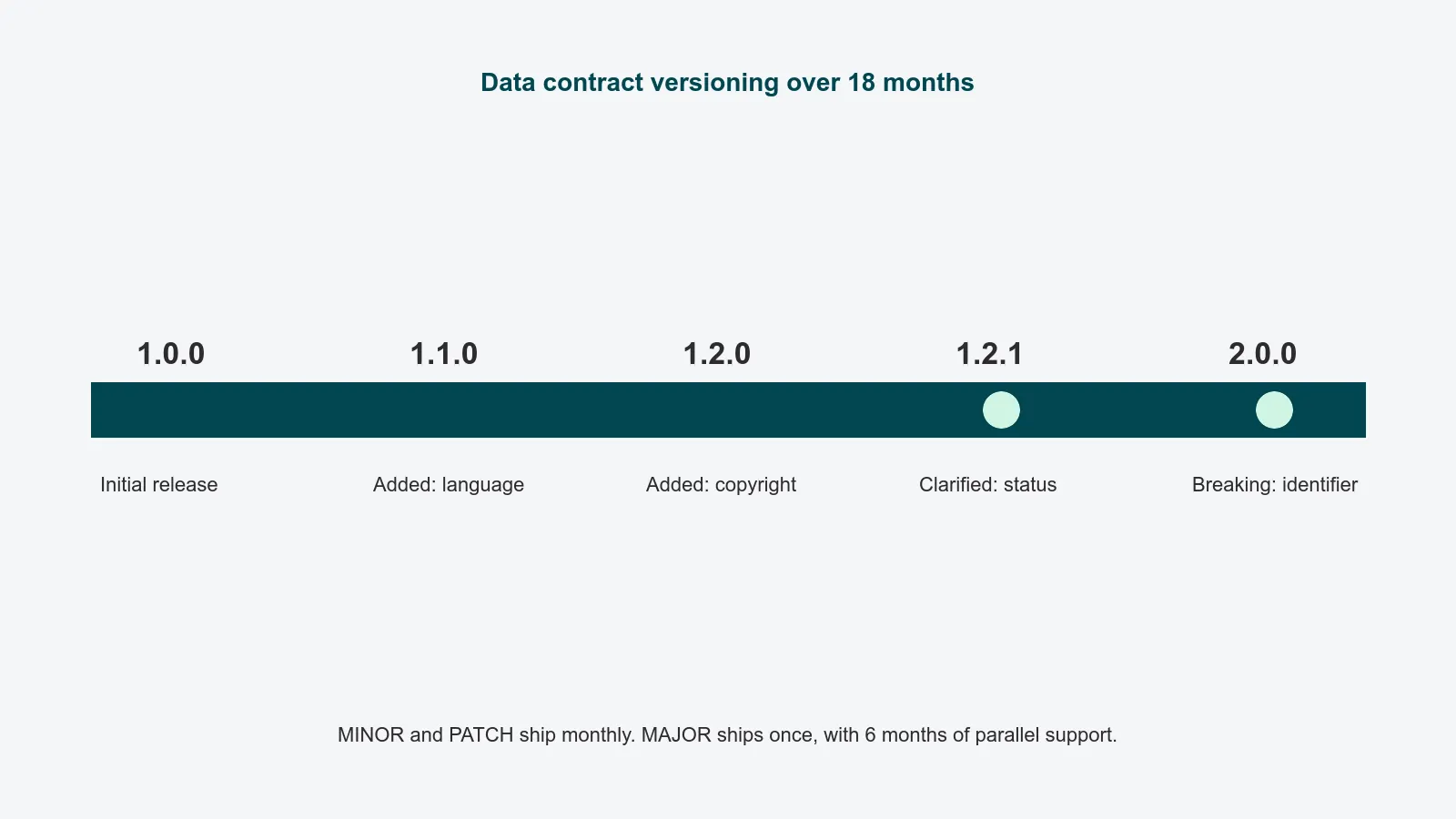
The point of the rule is not bureaucracy. It is that a consumer who has integrated against 1.2.0 knows they can safely accept any payload labelled 1.x.y without rewriting their parser. That single guarantee is the difference between a contract you can ship to ten channel partners and one you can only ship to one.
Backwards compatibility and deprecation
Three rules keep a contract honest as it ages:
- Fields are added, never repurposed. If you ever need to change what a field means, give the new meaning a new field name. The old field stays, with the old semantics, until it is formally deprecated.
- Renames go through deprecation. Want to rename
usagetousageRights? ShipusageRightsas additive in v1.3.0, markusageas deprecated in the schema, keep emitting both in parallel, and removeusageno earlier than the next MAJOR version. - Minimum 6 months of parallel support after deprecation. The studio keeps publishing the deprecated field for at least six months after the announcement, so every PIM consumer has time to migrate during their own release cycle. Aggressive teams ship parallel for 12 months.
Pair the rules with a change-notification cadence. A monthly contract changelog email - even an automated diff against the previous schema version - saves the integration architect three meetings a quarter. Mention the version, the change type, the deadline, and a link to the updated schema. Nothing more.
Pick a validation format and version-control it
Three formats cover almost every studio-to-PIM contract in the wild: JSON Schema, OpenAPI, and Avro.
- JSON Schema is the lowest-friction choice. The payload is JSON, the schema is JSON, every modern language has a validator. Good default for HTTP webhooks.
- OpenAPI is a superset that also describes the transport - the endpoint, the headers, the auth. Pick this when the contract covers more than one event type or when you want to generate client SDKs from the spec.
- Avro is worth the overhead only when you are publishing through Kafka or another binary streaming layer at high volume. The schema registry it brings is excellent; the tooling is heavier than most studios need.
Whichever you pick, treat the schema file the way you treat code:
- Check it into git, in a path like
contracts/asset-event/v1.2.0.json. - Tag releases (
asset-event-1.2.0) so a consumer can pin to a known revision. - Run the validator on every outbound payload in CI, not just at runtime. A schema that does not match the actual emitted payload is worse than no schema at all.
- Publish the schema at a stable, versioned URL. The
$schemafield in the payload above points at it directly.
Webhook vs polling - keep delivery out of the contract
The contract describes the payload, not the wire. The same asset.approved event can be delivered by webhook, by polling, or by SFTP drop, and the consumer should not need to change a single field to switch.
That said, webhook is the right default for asset events. They are low volume, they are time-sensitive, and the signed-delivery patterns are well understood - covered in detail in asset-approved webhook publish patterns (sibling article). Polling is a sensible safety net under a webhook integration; the broader pattern catalogue is in connecting your studio to PIM and ERP.
The decision the contract owner makes is which delivery mechanisms are supported. The decision the integration owner makes is which one to use. Keeping them separate means a future migration from polling to webhooks is a runtime change, not a schema change.
A conformance test suite both sides run
A schema validates shape. A conformance suite validates behaviour. Ship both.
A minimal conformance suite for an asset contract has maybe twenty test cases:
- A payload at the current MAJOR.MINOR validates clean.
- A payload missing an optional field still validates.
- A payload with an unknown field - one the consumer has not seen yet - is accepted, not rejected. (Forward compatibility.)
- A payload with a deprecated field still parses, with a warning.
- An
assetRefresolves to a 200 on every rendition listed. - A
checksumactually matches the bytes the resolver returns. - An
effectiveFromin the future does not show up in published feeds.
Both sides run the suite - the studio against its emitter, the PIM against its parser. Run it on every release, not just on the first integration. The second time the PIM team rolls out a new version, the same fifteen-minute test catches the regression that would otherwise have been a week-long postmortem.
What about Akeneo, inriver, Salsify, Pimcore?
The PIM ecosystem matters here only because you do not have to invent the receiver. Akeneo, inriver, Salsify, and Pimcore all accept asset references through standard schema-driven imports - JSON, REST, sometimes Avro on the enterprise tiers. The connector you write maps your contract to whichever flavour the PIM exposes.
What that means in practice: design the contract for the studio's needs first, then write a thin adapter per PIM. Do not let one PIM's quirks leak into the contract - the moment you do, you have either coupled yourself to that vendor or built a contract no other PIM can consume. The contract is yours; the adapters are negotiable.
What good looks like
If you want to know whether your studio-to-PIM contract is healthy, run it past these five questions:
- Can a new PIM consumer integrate against the schema URL without reading any internal documentation?
- Has anything been renamed without a 6-month deprecation window in the last year?
- Does the conformance suite run in both teams' CI, on every release?
- Are asset URLs opaque, so a DAM reorganisation never reaches the PIM?
- Can you point to a changelog of versions, with dates, going back twelve months?
Five "yes" answers and the integration will probably still work next year. Architects working through this end-to-end usually find it sits naturally in the Head of Content's remit, with the platform side covered by PixelAdmin Integrations and the publishing side by Distribution. The full handoff from approved asset to live storefront is walked through in from shoot to storefront.
If you want a working session on your own contract - fields, versions, and conformance suite - book an integration architecture review and we will sit with your PIM team and write the first version together.