

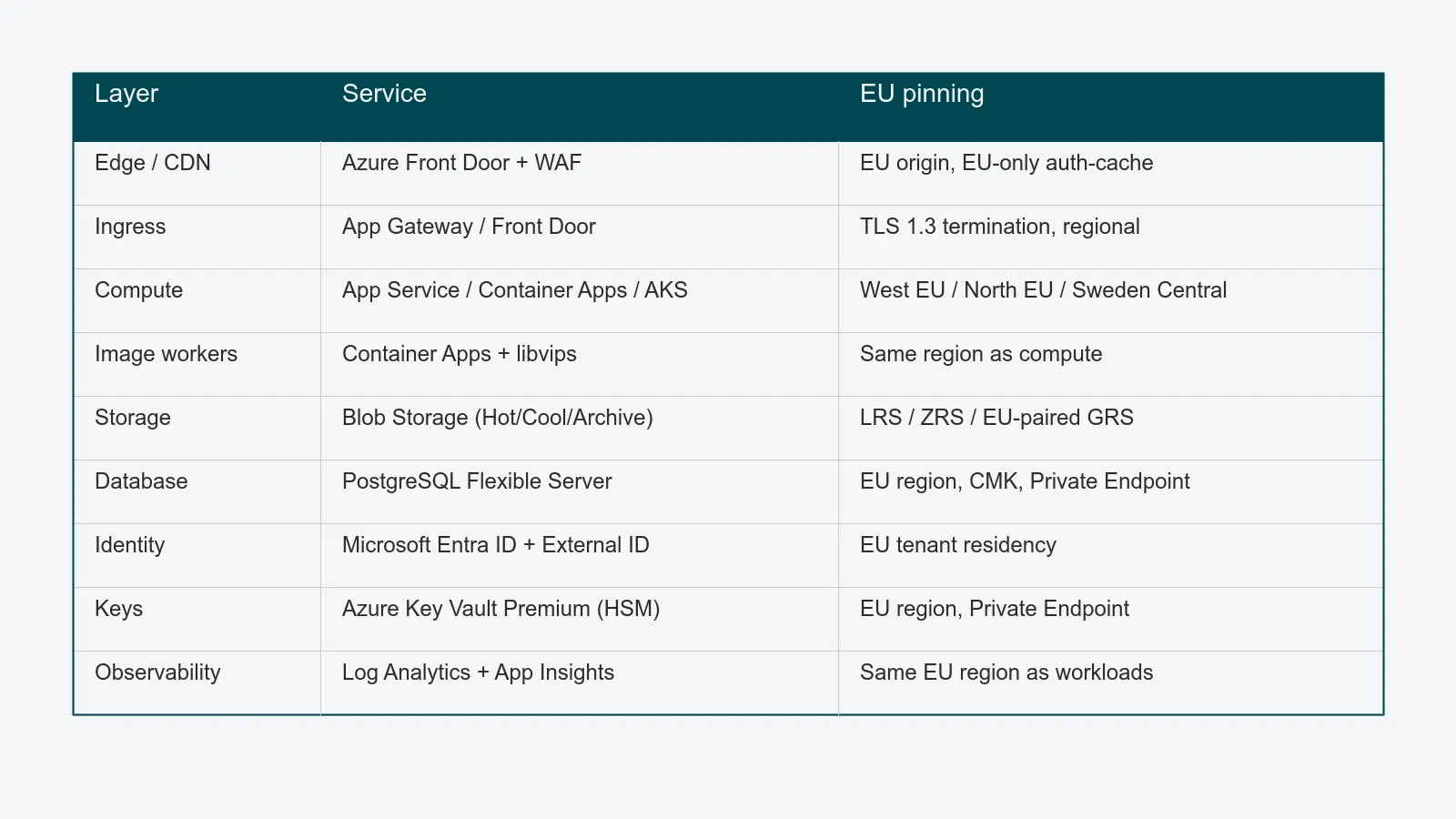
If you are the architect in the room when procurement asks "is the platform really EU-hosted?", the marketing region label is not the answer. The answer is a diagram: which Azure region holds the primary database, which one the blob storage, where backups land, how the front door routes traffic, where logs are stored, who holds the keys, and which sub-processors sit beside the production data path. Every one of those layers can quietly cross the EU boundary without anyone editing a slide.
This article is the architect-level anatomy of an EU-hosted creative SaaS stack on Azure. It is vendor-neutral by intent - PixelAdmin runs this pattern, but the choices below are the same whether you are designing a DAM, a tethered-capture platform, a review tool, or a full content operations suite. The companion piece on data residency for creative teams covers the legal layer; this one stays in the infrastructure.
TL;DR
- Region pinning is the foundation. West Europe (Amsterdam), North Europe (Dublin), and Sweden Central are the three workable primaries; their Azure-paired regions matter for disaster recovery.
- Compute, storage, database, identity and CDN all need to be region-pinned independently. A single misplaced service breaks the residency story.
- Customer-managed keys in Azure Key Vault Premium plus Private Endpoints on every data-plane service close the two largest sub-processor gaps.
- The EU Data Boundary covers most customer data and pseudonymous service data, but does not automatically cover every telemetry path or support flow - you have to design those in.
- The pattern is documented end-to-end in Microsoft Learn. Architects who can read the docs and pin the topology end up with a defensible diagram; the rest end up with a marketing claim.
Region pinning is the foundation, not a footnote
Three Azure regions are practical primaries for an EU-hosted creative SaaS in 2027:
- West Europe (Amsterdam) - broadest service coverage, the default for EU-headquartered SaaS, generally the lowest latency for Benelux, France, Germany.
- North Europe (Dublin) - near-feature-parity with West Europe, paired with West Europe for replication, often picked when the customer footprint skews toward UK and Nordics.
- Sweden Central - lower carbon intensity, the strongest sovereignty narrative for Nordic public-sector buyers, and now broadly featured for storage and Postgres.
Each Azure region has a paired region for service-managed replication. West Europe pairs with North Europe; North Europe pairs back with West Europe; Sweden Central is paired with Sweden South. All three pairings stay inside the EU, which is the property you actually want - geo-redundant storage that pairs an EU primary with a non-EU secondary is a residency leak dressed up as resilience.
The architect's job is to write the region into the deployment, not into a runbook. In Bicep or Terraform, every resource group, storage account, key vault, Postgres flexible server, App Service plan, Container Apps environment, and Log Analytics workspace gets location set explicitly to the chosen region - never ${parameters.location} with a default that silently drifts.
Compute: App Service, Container Apps, or AKS
There is no single right compute target for content workloads. There is a right one per workload.
Azure App Service is the workhorse for the application tier - the API, the web UI, the admin app. It carries the platform's request-response traffic, plugs into Entra ID, and supports VNet integration plus Private Endpoints. For most teams it is the cheapest, most managed option that still meets the residency and isolation requirements.
Azure Container Apps fits well for image-processing workers, webhook receivers, and the fan-out jobs that creative pipelines generate - re-rendering thumbnails, regenerating IIIF tiles, packaging deliverables. It scales to zero, takes a Dapr or KEDA scaler, and runs entirely inside a VNet when configured with the workload-profile environment.
AKS is justified when you are running long-lived GPU work (high-volume background removal, model inference at studio scale) or when you need a service mesh for tight east-west isolation between tenants. For most pure-SaaS creative platforms it is overkill - the operational cost of running AKS well rivals the cost of the platform itself. Use it where you must, not by default.
What matters across all three: the runtime sits in the chosen EU region, the egress is gated by a NAT or Firewall in the same region, and image pulls come from a regionally pinned Azure Container Registry - geo-replicate within EU only.
Storage: blobs, files, and the geo-redundancy trap
Creative SaaS storage divides into three layers:
- Blob Storage for assets - RAW captures, retouched masters, derivatives. Hot tier for working assets, Cool for the long tail, Archive for legal-hold material that has to stay accessible but not online.
- Azure Files or Azure NetApp Files for working sets that need POSIX semantics - render scratch space, retouching ingest folders, anything the application accesses as a mounted share.
- Managed disks for any state attached directly to a VM or AKS node.
The trap is the redundancy setting on the storage account. Each option has a residency implication that does not always show in the UI:
- LRS (locally redundant) - three copies inside one data centre; cheapest, smallest blast radius, no DR.
- ZRS (zone-redundant) - three copies across availability zones in one region; the right default for a single-region production storage account.
- GRS / RA-GRS - six copies, three in the primary region and three in the paired region. Inside the EU pairings (West/North Europe, Sweden Central/Sweden South) this is fine. Outside EU pairings, this is how data leaks.
- GZRS / RA-GZRS - zone-redundancy in the primary plus a paired-region copy. Same residency rule.
Set the redundancy explicitly per storage account and audit it in policy. A single "GRS by default" template applied to a US-paired region will quietly start replicating master files to North America the day someone runs terraform apply.
Database: PostgreSQL Flexible Server, encrypted properly
Most creative platforms run on PostgreSQL - it handles the relational metadata, the workflow state, the audit log, the comments. Azure Database for PostgreSQL Flexible Server is the EU-pinnable PaaS option.
The architect-grade configuration:
- High availability with same-zone or zone-redundant standby inside the chosen EU region, never cross-region failover that crosses the boundary.
- Customer-managed keys (CMK) for transparent data encryption, with the key in Azure Key Vault Premium in the same region, fronted by a Private Endpoint.
- Private access mode with VNet integration - never public endpoint with firewall rules.
- Azure-native point-in-time restore stays inside the region; cross-region restore is opt-in and should stay opt-in unless the second region is also EU.
- Microsoft Entra ID authentication for human and workload identities; Postgres-native passwords only for the bootstrap account, rotated and locked away.
Backups inherit residency from the server. Verify it; do not trust the marketing summary.
Identity: Microsoft Entra ID and tenant residency
Identity is the most commonly mis-explained piece of an EU-hosted stack. Microsoft Entra ID (formerly Azure AD) is a global service. Your tenant has a residency - Microsoft documents which European, North American, or other geo holds the directory data - but the service itself authenticates everywhere.
For an EU-hosted creative SaaS, three patterns matter:
- Single-tenant SaaS, EU tenant residency - your application registers in your own EU-residency Entra tenant; customers federate via OIDC from their tenants. This is the most common architecture and keeps directory data in the EU geo.
- Entra External ID (the successor to B2C) - for invited collaborators (freelance retouchers, brand reviewers) who do not have a corporate IdP, use External ID configured in an EU region. The directory containing those external users sits in the EU.
- B2B guest invites - Entra B2B has its own residency rules; the guest user object is created in your tenant.
For both patterns, configure conditional access policies, MFA, and identity protection in the same tenant - those signals stay with the directory.
Encryption posture: TLS 1.3, AES-256, CMK, and double encryption
The boilerplate of "AES-256 at rest, TLS in transit" is necessary and not interesting. The interesting part is what sits behind it.
- TLS 1.3 terminated at Azure Front Door or Application Gateway, with TLS 1.2 as the minimum back-stop. Older clients are not a reason to keep TLS 1.0 on.
- AES-256 at rest via Storage Service Encryption, on by default, but pointed at a customer-managed key in Key Vault Premium. The key is HSM-backed (FIPS 140-2 Level 3) and bound to the same EU region.
- Double encryption - both Azure Storage and Azure Disks support infrastructure-level encryption on top of platform encryption. Useful for the legal-hold archive tier and for highly sensitive customer data.
- Per-tenant encryption - for multi-tenant SaaS, derive a per-tenant data-encryption key from the customer's own key in Key Vault. This is the strongest answer to "if Microsoft is subpoenaed, can our data be read?" - and the one most architects skip.
CDN and edge: Azure Front Door with EU PoPs
For asset delivery you need a CDN; for a creative platform you also need rapid cache invalidation when an asset is replaced or a contract changes. Azure Front Door is the right primary, configured with WAF, caching rules, and Private Link origin so the storage account is not directly internet-facing.
Front Door is global by design - its anycast edge runs PoPs across the planet - but you can constrain origin selection and direct cache to EU PoPs through routing rules. Cached bytes at non-EU PoPs are a residency consideration; for content that is genuinely public (marketing imagery on a CDN-fronted page) it is normally acceptable, for any asset gated behind authentication it is not, and you should disable caching there.
Networking: Private Link, Private Endpoints, no public egress
The architect's checklist for the network:
- Every PaaS data-plane service - Storage, Postgres, Key Vault, Container Registry, Service Bus, Cosmos if used - terminates on a Private Endpoint in the production VNet.
- Public network access on each of those services is disabled at the resource level, not just locked down with a firewall rule.
- Outbound egress goes through Azure Firewall or a NAT Gateway in the same region. No service goes out via implicit egress on a public IP.
- DNS for the privatelink zones is hosted in Azure Private DNS in the same subscription; no on-prem resolver is in the path.
- VNet peering is regional and stays inside the EU; cross-region peering is reserved for the EU paired region only.
This is also what makes the sub-processor governance story defensible - when production data never leaves a private network in an EU region, the question of which CDN PoP a stray request hit becomes academic.
Image processing: managed AI vs in-app libvips
Creative platforms make a sub-processor choice the moment they decide who does the pixel work. Two patterns:
- Azure AI Vision (formerly Computer Vision) - managed image tagging, OCR, and content moderation. Microsoft hosts the model; the data is processed in the chosen region; for many use cases it is the right answer. The trade-off: AI Vision is in your sub-processor list as a Microsoft service, the customer's DPO will see it, and you should explain why.
- In-app processing with libvips, ImageMagick, or sharp - running inside your own Container Apps or AKS workers. No additional sub-processor. Slower to build out features (you write the moderation pipeline yourself) but the residency and processing story is "us, in the same region, no third party."
The right answer depends on the feature. Background removal at studio volume is hard to write in-house and easy to consume from a managed service; bulk thumbnail rendering and format conversion are commodity work libvips does in milliseconds and there is no reason to outsource it. Be deliberate; document the choice in the Transfer Impact Assessment and the DPA.
The EU Data Boundary, and what is and is not in scope
The Microsoft EU Data Boundary commits Microsoft to processing customer data and pseudonymous personal data of EU customers within EU and EFTA regions for a defined set of services - including most of Azure. That commitment is the spine of the residency story. It is not the whole skeleton.
What architects need to verify article-by-article:
- Customer data in scope services stays in the EU geo.
- Pseudonymous service-generated data (telemetry, diagnostic logs in covered services) is processed in the EU.
- Support routing can still cross the boundary if the customer's case requires global engineer access - Microsoft has documented when and how. The customer can request EU-only support data handling for many services.
- Some Microsoft services, particularly across Microsoft 365 boundaries and certain telemetry pipelines, still flow data outside the boundary by design. Read the per-service notes; do not assume.
For a creative SaaS architect, the practical takeaway is: choose Azure services where the boundary commitment is explicit, configure them in EU regions, and document any exception in the sub-processor list and DPA.
Observability with EU-pinned data
Observability is where many residency stories quietly break. Application Insights and Log Analytics both have a regional storage location that you set when the workspace is created and cannot change later. Pin the workspace to the same EU region as the workloads it observes; route every diagnostic setting on every PaaS service into that workspace.
Two architecture notes:
- Use a single regional Log Analytics workspace per environment (production, staging) rather than fanning out to multiple. It simplifies the residency map and the access controls.
- For long-term retention, archive to a regional Azure Storage account with immutability policies rather than to an out-of-region SIEM. SIEM ingestion is fine if the SIEM is also EU-hosted; otherwise it becomes a sub-processor and a residency exception.
Roles like Head of Content Production usually push back when telemetry escapes the residency story; build the observability layer so you do not have to negotiate it later.
Backup, disaster recovery, and EU-only geo-redundancy
Disaster recovery is where residency and resilience meet head-on. The pattern:
- Primary region: West Europe, North Europe, or Sweden Central.
- DR region: the Azure paired region, all inside the EU.
- Storage: GZRS or GRS, but only because the pair stays in the EU.
- Postgres: cross-region read replica or geo-restore enabled into the EU paired region.
- Key Vault: regional with soft-delete and purge protection; if you replicate keys, replicate inside the EU.
- Recovery Services Vault (Azure Backup): same-region, with GRS only when the paired region is in the EU.
Document the RPO and RTO per system. Test the DR runbook on a real cadence - the day a region goes down is the wrong day to discover that the failover path silently routes through a non-EU service.
Architect's verification checklist
Before signing off on a creative SaaS stack as EU-hosted, verify each row in your IaC and in the live environment:
- Every resource has
locationset to a specific EU region - no defaulting through a parameter chain - Storage account redundancy is LRS, ZRS, GRS or GZRS where the paired region is also in the EU
- Postgres flexible server uses CMK with the key in an EU Key Vault Premium
- All PaaS data-plane services use Private Endpoints; public network access is disabled at resource level
- Egress goes through a regional Azure Firewall or NAT Gateway
- Front Door, WAF and origin are wired so cached private content does not land at non-EU PoPs
- The Entra tenant residency is EU; External ID directories are in EU regions
- Log Analytics and Application Insights workspaces are in the same EU region as the workloads
- Backups, replicas and recovery vaults all replicate inside EU pairings only
- Image processing AI services, if used, are documented in the sub-processor list and DPA
If any row is unverified, the residency story is a slide, not an architecture.
Where to go from here
A defensible EU-hosted creative SaaS stack on Azure is not a single decision - it is roughly forty small ones, each correct on its own and consistent with the rest. The good news for architects is that Microsoft's Learn documentation is precise about each one. The bad news is that the marketing layer above it is not, which is why this anatomy exists.
If you are designing a new platform or auditing an existing one, the security posture page shows how PixelAdmin documents this for our customers, the DAM platform overview shows where the asset-storage path actually lands, and the companion piece on sub-processor governance covers the procurement layer that sits on top. When you want a second pair of eyes on your topology, book an architecture review and we will walk through it region by region.