

If you run a content studio in 2026, you have probably been handed a Transfer Impact Assessment template by a brand client's procurement team and asked to fill it in for every image SaaS in your stack. The template is long, the language is legal, and most of the rows ask about transfers your team did not know were happening. The work is not optional - it is the documented basis on which your platform choices stand or fall under Chapter V GDPR - but it is doable once you stop treating it as a legal puzzle and start treating it as an operational one.
This guide is for the Head of Content who has to run the assessment, and the DPO who has to sign it. It covers what a transfer impact assessment image SaaS actually requires, when an image platform's data triggers one, the six-step structure from EDPB Recommendations 01/2020, what the EU-US Data Privacy Framework changes, and the documentation pack you hand the DPO at the end. This is not legal advice - validate the specifics with your DPO or counsel.
TL;DR
- A TIA is an Article 46 GDPR assessment that supplements your transfer mechanism (SCCs, BCRs, DPF) with a fact-based check that the transfer holds up against the importing country's surveillance regime.
- For image SaaS, personal data is in scope the moment your platform stores model imagery, recognisable BTS, signed releases, named review comments, or EXIF/IPTC fields tying images to identifiable people. Pure decontextualised packshot is the rare exception.
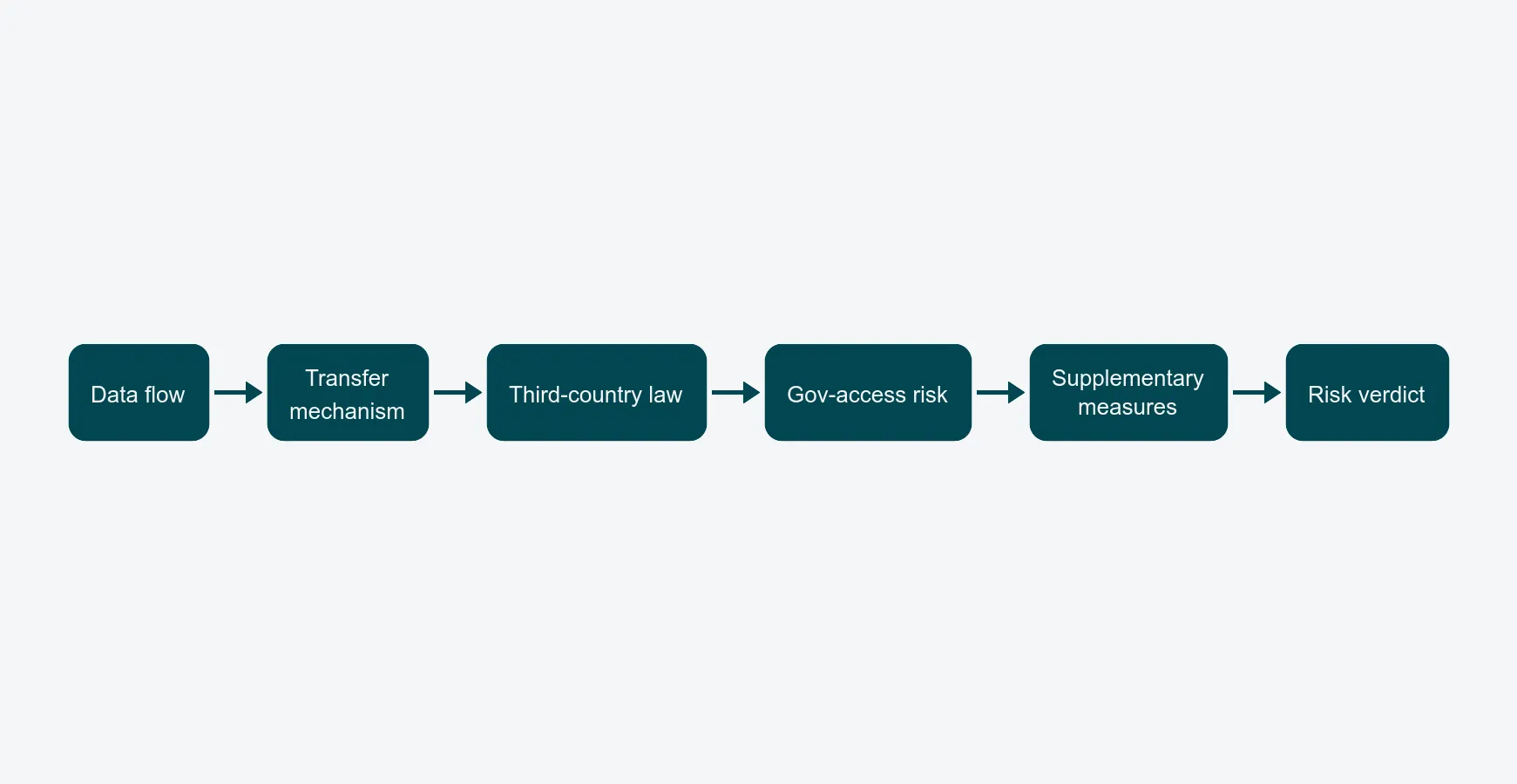
- The structure has six steps: data flow, transfer mechanism, third-country law, government-access risk, supplementary measures, risk verdict.
- DPF certification simplifies the transfer story for participating US image processors but does not remove the assessment - DPAs still expect a documented analysis, especially with the framework under active legal challenge.
- Sub-processors cascade. Every sub-processor in a non-adequate country needs its own mini-TIA referenced from the parent.
What a TIA actually is, in plain terms
A Transfer Impact Assessment is the documented analysis a controller performs before relying on a Chapter V GDPR transfer tool - typically Standard Contractual Clauses, but also Binding Corporate Rules and adequacy-based mechanisms like the Data Privacy Framework. Schrems II made clear in 2020 that a transfer mechanism by itself is not enough: the controller must assess whether the importing country's law and practice prevent the mechanism from being effective in the specific case, and if so, what supplementary measures bring the transfer back in line.
The EDPB's six-step Recommendations have become the working template for almost every TIA you will see. National DPAs lean on the same structure - the CNIL's transfer guidance and the ICO's international transfers guidance walk through equivalent logic.
Plainly: the TIA is the file your DPO opens when a regulator or brand auditor asks "you signed SCCs with this US image vendor - what did you actually check?" If the answer is the SCCs themselves, you are exposed.
When image SaaS data is, and is not, personal data
Most TIA work in a content studio gets stuck on the threshold question: is this even a transfer of personal data? The answer is more often yes than studio managers expect, because image platforms quietly process several layers of personal data at once.
In scope when:
- Model imagery is stored, transcoded, AI-tagged, or reviewed - RAW, retouched, and outtake.
- Behind-the-scenes content captures recognisable employees, freelancers, or visitors.
- User-submitted images flow into the platform from end customers, influencers, or brand-managed UGC pipelines.
- Model releases and contracts sit alongside the assets - they are themselves personal data and the legal basis for everything else.
- Review comments and approvals carry named feedback inside the platform, which under GDPR is also personal data.
- EXIF and IPTC metadata ties an image to a photographer, a device, a location, or a rights holder.
Out of scope is rarer than it sounds. Pure packshot - a folded shirt on white seamless, no model, stripped EXIF, no named reviewer comments - is genuinely not personal data. The moment a sleeve is held by a hand model, a stylist appears in a BTS frame, or a campaign brief lists named talent, you are back in Article 4 territory. Our piece on GDPR for content studios and model releases covers the consent layer underneath; this article assumes you have that and focuses on where the bytes flow.
The six-step TIA, applied to image SaaS
The EDPB's six steps map cleanly onto an image platform. Each step produces a section in the final document.
Step 1 - Map the data flow
List every flow of personal data into and out of the SaaS. For an image platform that typically includes asset upload, AI processing, thumbnail and preview generation, search indexing, support access, telemetry, backups, and any export or distribution pipeline. For each flow, note the data categories (model imagery, releases, review comments, metadata), the volume, and the sensitivity. A vendor who hands you a single-line "data flow: customer uploads images" answer has not given you a TIA input.
Step 2 - Identify the transfer mechanism
Pin down the legal tool you are relying on for each non-EEA leg. Adequacy decisions are simplest - a transfer to a country on the Commission's adequacy list needs no further mechanism. SCCs are the most common fallback. Binding Corporate Rules apply to intra-group transfers in larger vendors. The EU-US Data Privacy Framework, restored by the Commission's 2023 adequacy decision, removes the need for SCCs for transfers to certified US importers - but only while the framework remains valid.
Step 3 - Assess third-country law and practice
Look at whether the importing country's law and practice undermine the mechanism. For the US this means the FISA 702 regime, Executive Order 12333, and the redress mechanism EO 14086 introduced as the basis for DPF. For other jurisdictions, the EDPB references applicable surveillance and access laws and the practical likelihood that the transferred data type is captured. For image SaaS the relevant question is: are creative production assets and their associated personal data realistically a target for bulk access, or is the risk theoretical?
Step 4 - Evaluate the actual government-access risk
Step 4 is where most TIA templates collapse into hand-waving. Done well, it asks: given the data type (creative production imagery, contracts, review threads), the volume, the sensitivity, the access patterns, and the importer's role under the relevant statutes, what is the realistic risk that an authority requests this data, and that the request lands within the importer's compliance obligations? A US image processor that is not an "electronic communication service provider" under Section 702 sits in a different risk class than a hyperscaler. The honest answer is sometimes "low" and sometimes "non-trivial" - the file should say which, and why.
Step 5 - Supplementary measures
Where the risk is non-trivial, the EDPB Recommendations describe technical, contractual, and organisational measures that bring the transfer back to the GDPR's "essentially equivalent" standard. For image SaaS the technical measures matter most:
- Encryption in transit - TLS 1.3 across every public endpoint and every sub-processor leg.
- Encryption at rest - at the storage layer, ideally with envelope encryption.
- EU-only key custody - Bring-Your-Own-Key in an EU Azure Key Vault or an equivalent HSM, so the importer cannot decrypt without your participation. Hold-Your-Own-Key (HYOK) is stronger again where the workload allows it.
- Pseudonymisation of model-release metadata - strip or hash the direct identifiers in EXIF/IPTC before they are sent to a non-EU sub-processor (an AI tagger, a search index).
- Network controls - egress restrictions, private endpoints, no public administrative access.
Contractual measures - strict notification obligations, transparency reports, challenges to overbroad requests - supplement the technical layer rather than replace it.
Step 6 - Risk verdict and review cadence
The final step is a documented decision: proceed, proceed with measures, or do not transfer. Tie the verdict to a review cadence - at minimum annually, and on any material change to the importer's status, the legal landscape, or the data flow. The verdict is the line your DPO countersigns.
What the EU-US Data Privacy Framework changes (and what it does not)
The 2023 DPF adequacy decision is the most significant change to the transfer landscape since Schrems II. For a US image processor that is DPF-certified - listed on the Data Privacy Framework portal under the EU-US DPF with the relevant data categories in scope - transfers from your EEA studio no longer require SCCs.
What it does not remove is the rest of the analysis. Several DPAs and noyb's ongoing challenges treat DPF as adequacy-on-condition rather than full equivalence. As of mid-2026 the framework is intact, but cautious DPOs still expect:
- A documented confirmation that the importer's certification covers the data categories you are transferring.
- A residual TIA covering surveillance laws and the redress mechanism, kept ready in case the framework is invalidated.
- A fallback transfer plan, usually SCCs, that can be executed quickly if needed.
Practically, a DPF-certified US image processor reduces the TIA from "high-effort at every renewal" to "lighter, but still maintained." An EU-hosted image SaaS sidesteps the question entirely for the primary processing path - though sub-processors can re-introduce it.
Cascading TIAs: the sub-processor problem
Article 28 GDPR makes processors liable for their sub-processors, and Article 46 makes you, the controller, ultimately responsible for every leg of the transfer chain. Every sub-processor in a non-adequate country triggers its own assessment.
For image SaaS the usual suspects are AI vendors, error-tracking tools, support helpdesks, analytics, and email delivery - and sometimes the storage tier itself. Three rules keep the cascade manageable:
- Demand the full sub-processor list from your processor, with country, role, and data categories per entry. A summary is not enough.
- Reference the parent assessment in each sub-processor mini-TIA so the file is navigable, not duplicative.
- Constrain sub-processor changes contractually - prior notice, right to object, exit triggers - so you are not running a fresh TIA every quarter.
The sibling article on sub-processor governance for content SaaS goes deeper on the contractual and operational mechanics; this article keeps the focus on the TIA itself.
What the DPO actually receives
A defensible TIA pack, in our experience, contains these artefacts in one folder per platform:
- The TIA document - six sections matching the EDPB steps, dated, with a named author and signatories.
- The data flow diagram - visual or tabular, covering primary processing, AI workers, search, support, backups, and any export pipeline.
- The processor's DPA - including the sub-processor list and data location annex.
- The transfer mechanism evidence - adequacy decision reference, executed SCCs, or DPF certification listing.
- Audit evidence - the latest ISO 27001 certificate or SOC 2 report from the processor.
- Supplementary-measure documentation - encryption posture, key custody, network controls, pseudonymisation of metadata.
- A review log - when it was last reviewed, by whom, and what changed.
When a brand auditor or a DPA asks the question, that folder is the answer. The work in front of it - the assessment itself - is most of the cost; the work behind it - keeping the folder current - is most of the discipline.
Practical TIA checklist for image SaaS
Before your next vendor renewal or new platform decision, walk through this:
- You have an inventory of every image SaaS in scope, with data categories noted per platform
- Each platform has a documented data flow covering ingest, processing, support access, backups, and any export
- The transfer mechanism is identified per non-EEA leg, with the supporting evidence on file
- Government-access risk is assessed concretely, not generically, against the data type and volume
- Supplementary measures are technical first - TLS 1.3, encryption at rest, EU-only key custody, pseudonymisation of release metadata
- Sub-processors have their own mini-TIAs, with contractual change controls in place
- The TIA pack is filed where your DPO and a brand auditor can find it without a back-channel request
- A review cadence - annual at minimum, plus on material change - is in the calendar
If two or more rows are uncomfortable, the gap is process, not law - which means it is fixable.
Where to go next
A TIA is structurally simpler when the primary processing path stays inside the EEA, the keys stay in an EU Key Vault, and the sub-processor list is short and documented. PixelAdmin runs on Microsoft Azure in EU regions, and we keep the artefacts above ready for Heads of Content and DPOs who arrive with a brand-client TIA template in hand. Our security posture and Data Processing Agreement cover the controls; the DAM module is where the model releases and asset retention rules sit; the residency story lives in our companion piece on EU data residency for creative teams.
If you would like to walk a current vendor through the six steps with us, book a call and we will go section by section.