

When a brand client's procurement team rejects a content SaaS contract in the last week of negotiation, it is rarely the price. It is almost always the sub-processor list - too short to be credible, too long to be defensible, or simply not aligned with what the vendor's own DPA says. Sub-processor governance is the part of vendor selection that quietly decides whether the platform you signed up for actually closes a deal with your largest client, or sits in legal review for another quarter.
This guide is for Heads of Content Production (and the DPOs they work with) buying or renewing a content SaaS - DAM, workflow, review, AI image processing, anything that touches identifiable people. It covers what Article 28 GDPR actually requires, what a usable sub-processor list looks like, the change-notification clauses worth fighting for, and a practical scoring rubric you can apply tomorrow.
This is not legal advice. Use it as a structured starting point and validate the specifics with your DPO or counsel.
TL;DR
- A sub-processor is anyone your processor brings in to help process your data - cloud hosting, AI image services, support tooling, error monitoring, CDN. Under Article 28(2) and 28(4) GDPR, each one needs your authorisation and the same data-protection obligations as the main processor.
- A usable sub-processor list has six fields per entry: name, region, purpose, data categories, transfer mechanism, encryption posture. Anything less is not really a list.
- A 30-day change-notification clause with a documented right to object is the market standard for content SaaS. Shorter is suspicious. Silent updates are a deal-breaker.
- The evidence pack you ask for is the same every time: signed DPA, sub-processor's own DPA with the vendor, current ISO 27001 / SOC 2 report, latest pen-test executive summary, transfer mechanism (SCCs or adequacy), and TIA where applicable.
- Score each sub-processor low / medium / high risk. A handful of mediums is normal. A high-risk sub-processor needs a written justification or it gets removed.
Article 28 in plain language
Three roles matter for governance: controller, processor, sub-processor. Your studio (or the brand whose content you produce) is the controller - you decide why and how personal data is processed. The content SaaS is your processor - it acts on your instructions. The processor's own vendors - Azure, AWS, an AI image service, Zendesk, Sentry, a CDN - are sub-processors.
The EDPB Guidelines 07/2020 on the concepts of controller and processor make two points worth internalising. First, the controller carries the obligation even when the data is downstream - you cannot subcontract accountability. Second, sub-processors must be bound by the same data-protection terms as the main processor, in writing, before they touch your data.
In practice Article 28 gives you four levers:
- Authorisation - general or specific. Most modern DPAs use general authorisation with a published list. Specific authorisation is rare in SaaS and typically not workable.
- A list you can read. The vendor must keep it current and make it available to you.
- Change notification with a right to object. When a new sub-processor is added or replaced, you get notice and a window to object - and an exit if the objection is not resolved.
- Cascading obligations. The vendor's contracts with their sub-processors must mirror the protections in your DPA - including transfer mechanisms, security controls, and audit rights.
If any of these four is missing, governance is not happening. The contract may be signed; the regime is not in place.
What a usable sub-processor list actually looks like
A line that says "Microsoft Azure - hosting" is not a sub-processor list. It is a marketing artefact. The list you can actually govern has six fields per entry, and your DPO will want every column populated:
- Name - the legal entity, not just the brand. "Microsoft Ireland Operations Limited" is more useful than "Microsoft Azure."
- Region - primary processing region, plus any backup or failover region. "EU (West Europe)" with the failover named.
- Purpose - one short, concrete sentence. "Object storage for retouched masters." Not "infrastructure services."
- Data categories - what actually flows. Asset files, EXIF/IPTC metadata with photographer names, review comments, model release PDFs, support tickets containing image thumbnails.
- Transfer mechanism - adequacy decision, Standard Contractual Clauses, Binding Corporate Rules, or DPF - and a pointer to the executed instrument.
- Encryption posture - at rest (algorithm, key custody), in transit (TLS version), and whether the sub-processor can read plaintext or only ciphertext.
IAPP guidance on sub-processor management consistently lands on the same point: the list is only as useful as the column you forgot to fill in. A vendor that publishes name and purpose only is not in a position to support your audit; a vendor that publishes all six is.
For content SaaS specifically, watch for sub-processors in three categories that often hide on shorter lists: AI image processing services (background removal, cropping, tagging), CDN providers (serving renditions to global clients), and support tooling (ticketing systems where screenshots end up). All three frequently sit in non-EEA regions. All three deserve their own row.
The change-notification clause worth fighting for
Sub-processor lists are not static. Vendors swap a CDN, add an AI provider, move a support tool, retire a region. The contractual question is what happens when they do.
The clause you want has four moving parts:
- Notice period. 30 days before the change takes effect is the market standard for content SaaS. Some vendors offer 14; that is acceptable for low-risk swaps if the rest of the regime is strong. Anything under 14 days is a flag.
- Channel. Email to a named compliance contact, plus a published changelog with timestamps. A quiet update on a documentation page does not count as notice.
- Right to object. You can refuse the new sub-processor in writing. The vendor then either keeps the previous arrangement, finds an alternative, or - if neither is workable - triggers the exit clause.
- Escalation. A clear path: compliance contact → account manager → vendor DPO → contractual termination with data return. Without escalation, "right to object" is theatre.
The deal-breaker pattern to watch for is the unannounced change - you discover via a status page or a customer email that a new sub-processor has been processing your data for weeks. Under Article 28 that is a breach of contract and, depending on the data category, a Chapter V issue if the new sub-processor is in a third country. Treat it as such, in writing, the day you discover it.
The evidence pack - what to ask for, every time
Before you sign, before you renew, and during your annual review, ask for the same documentation. Standardising the request protects you and shortens the legal cycle for the vendor.
The pack:
- The vendor's signed DPA, with the sub-processor list as an annex (not "available on request").
- Each material sub-processor's own DPA with the vendor, or at minimum the executed SCCs / adequacy citation. You don't need to read all of them; you need to know they exist and that the vendor can produce them under audit.
- A current ISO 27001 certificate and statement of applicability, or a SOC 2 Type 2 report - issued in the last 12 months. The hosting sub-processor (Azure, AWS, GCP) almost always has one; the smaller AI or support sub-processors sometimes do not, and that is information.
- The latest pen-test executive summary for the vendor's own platform, redacted as needed.
- Transfer Impact Assessment for every non-EEA flow. We covered the methodology in our companion piece on transfer impact assessments for image SaaS - that workflow cascades down through every sub-processor outside the EEA.
- Region pinning evidence - a screenshot or API response showing your tenant is bound to the contracted region, not just promised it. The residency story for EU-hosted creative SaaS only holds if you can verify it.
If the vendor cannot produce items 1–4 within a week, the rest of the conversation is theoretical.
A scoring rubric you can use tomorrow
The point of a rubric is to make the conversation with your DPO repeatable. Score each sub-processor low / medium / high risk against the same questions every time. A handful of mediums is normal - content SaaS depends on hyperscalers and a few specialist services, and few of them are pristine on every axis. A high-risk entry needs a written justification, a compensating control, or it gets removed.
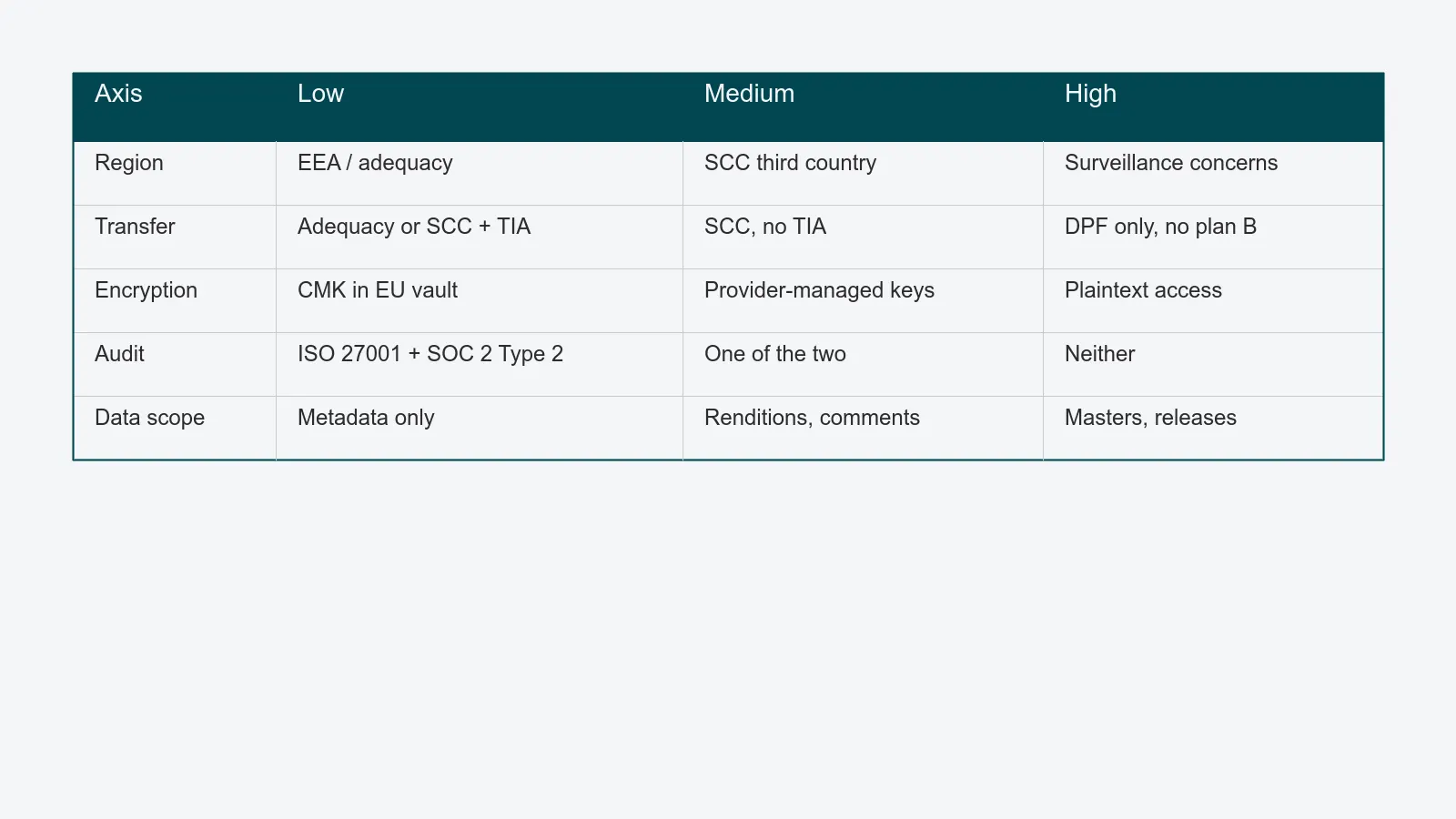
The five axes worth scoring:
- Region. EEA or adequacy country = low. SCC-covered third country with strong rule-of-law = medium. Third country with documented surveillance concerns = high.
- Transfer mechanism. Adequacy or SCCs + current TIA = low. SCCs without a TIA = medium. DPF only, with no fallback plan = high.
- Encryption posture. Customer-managed keys in an EU key vault, sub-processor cannot read plaintext = low. Provider-managed keys with strong segregation = medium. Sub-processor reads plaintext for legitimate reasons (e.g. AI processing) but with limited controls = high.
- Audit posture. Current ISO 27001 + SOC 2 Type 2 = low. One of the two = medium. Neither = high (and may still be acceptable for low-data-scope sub-processors like analytics on aggregated metrics).
- Data scope. Metadata only or aggregated telemetry = low. Renditions and review comments = medium. Raw masters, model releases, contracts = high.
A sub-processor with high scores on data scope and region and encryption is not one you accept by default - it is a sub-processor you either remove from the architecture or wrap in a compensating control (e.g. customer-managed keys, EU-only routing, contractual prohibition on plaintext access).
Annual review and the exit clause
Set a calendar reminder for the same week each year. Pull the current sub-processor list, diff it against last year's, and re-score everything that changed. The questions to answer in writing:
- Which sub-processors were added, removed, or moved region in the last 12 months?
- Did any change happen without proper notice? (If yes, raise it formally.)
- Have any sub-processors lost certifications or had a published incident?
- Has the data scope flowing to any sub-processor materially expanded - for example, a new AI feature now sending raw images to a service that previously only saw metadata?
The exit clause is the silent partner to all of this. A defensible DPA gives you the right, on termination, to require return or deletion of all your data - including from every sub-processor - within a defined window (30–90 days is typical), with a written certificate of destruction. If exit is wired into the DPA but not into the sub-processor cascade, it is wired into nothing.
A short pre-signature checklist
Before you sign or renew a content SaaS contract, walk through this with your DPO:
- The DPA names every material sub-processor with all six fields populated
- Change-notification clause is at least 14 days, with a written right to object and a defined escalation path
- You have the evidence pack (DPA, sub-processor DPAs / SCCs, ISO/SOC, pen-test summary, TIA, region pinning evidence) in a folder before the contract is countersigned
- Each sub-processor is scored low / medium / high on region, transfer mechanism, encryption, audit, and data scope
- No high-risk entry is unjustified or unmitigated
- Exit clause covers data return / deletion at the sub-processor level, not just the main processor
- An annual review is in your calendar, not in someone's head
If two or more rows are uncomfortable, the gap is operational rather than legal - which means it can be fixed before you sign.
Where to go next
Sub-processor governance is the part of compliance that gets harder, not easier, as your stack grows. PixelAdmin's security posture and DAM module are designed around a small, EU-hosted sub-processor footprint with all six fields published - so the conversation with your DPO is short. Heads of Content Production who want to compare their current vendor against the rubric above are welcome to book a sub-processor review; we will go entry by entry, and you keep the document at the end.
Related reading: our practical guide for the Head of Content Production role, and the companion compliance pieces on GDPR for content studios and EU-hosted SaaS data residency.